SLA First Closed Loop Feedback in 3 Months for CX & Insight Leaders
Learn how to build a closed-loop feedback programme that turns customer insight into action, with clear ownership, SLAs, KPIs and practical CX processes.
Closed-loop feedback is the discipline of collecting customer input, analysing it to reveal the real cause, acting on it, and closing the loop by telling the customer what changed. The single highest-leverage move is replacing static surveys with conversational follow-up that captures the “why”, then attaching a service-level agreement so a named owner must act. Everything else follows from getting that one seam right.
Only 10% of organizations act on customer feedback, and just 5% inform customers of the changes made, creating a significant gap in closing loops.
A successful closed-loop system follows four stages: collect, analyse, act, and close, with clear ownership and SLAs to ensure accountability.
Conversational follow-up and adaptive probing yield root causes more effectively than static comment boxes, enabling weekly feedback cycles.
Pilot programs should focus on a single touchpoint and decision, with SLAs of 24-48 hours for responses and 30-90 days for systemic fixes.
Tracking KPIs such as closed-loop rate, time to contact, resolution time, CSAT, and NPS delta is crucial to measure progress and justify leadership support.
Why closed-loop feedback matters now for CX, NPS and retention
Most CX programmes collect plenty and act on almost nothing. Research cited by Perspective AI shows 95% of organisations collect feedback, but only 10% act on it, and just 5% tell customers they did anything at all. That gap is where NPS improvements go to die.
Open loops cause two specific, measurable problems. Customers who flag a problem and hear nothing tend to churn quietly rather than complain twice, and survey response rates decay when respondents notice their previous answers vanished without trace.
The failure pattern repeats across sectors and looks remarkably consistent:
Skipping the "reveal" step and routing raw scores straight to a dashboard, with no analysis of why the score was given
No named owner for the action, so tickets sit in a shared inbox indefinitely
No SLA, meaning "we'll get to it" becomes the default response time
No echo back to the customer, so even genuine fixes generate zero trust or goodwill
Statistic worth sitting with: only 5% of organisations tell customers what they changed as a result of their feedback, according to Perspective AI’s research.
A compact operating model to close the loop
Strip away the vendor jargon and every credible closed-loop system runs on the same four stages: collect, reveal (analyse), act, and close. Practitioner guides converge on this model because it maps cleanly onto how organisations actually make decisions, splitting the work into an inner loop (the 1:1 response to one customer) and an outer loop (the systemic fix that stops the issue recurring for everyone else).
PROBE is a useful example of this model in practice: Probe the signal conversationally, Route it to the right owner, Own the resolution against a clock, Build the fix, Echo it back. The value of a framework like PROBE isn’t the acronym, it’s the discipline of single-owner hand-offs governed by SLAs rather than best-effort goodwill.
The weak seam in nearly every programme is Reveal in AI consultancy practice. A five-point rating tells you nothing routable on its own; a customer who types “not great, thanks” in a comment box has told you even less. Conversational follow-up, whether via a skilled interviewer or an AI-moderated interview, asks the natural next question a good researcher would ask, and that single extra exchange is often what converts a vague score into a root cause someone can act on.
Static comment boxes produce noise; adaptive probing produces routable themes
Thematic analysis that once took weeks can now run in hours, according to Koji's 2026 guide, which is what makes weekly loops realistic instead of quarterly ones
Pro Tip:Don’t ask “why” as a single follow-up question and stop there. The best conversational intake asks one clarifying question, listens, and asks a second only if the first answer is still too vague to route. Two good questions beat five generic ones.
How do you pilot closed-loop feedback in three months?
Prove the model works before you scale it. A pilot built around one concrete decision, such as an onboarding redesign, keeps feedback tied to a deliverable rather than drifting into open-ended wish lists, a point Koji’s guide makes well.
Pick one touchpoint and one decision it feeds (not the whole customer journey).
Choose two or three channels for that touchpoint, such as a post-interaction survey and a support-ticket tag, and run the pilot for around three months.
Write the SLAs before launch: 24 hours to acknowledge, 48 hours for an inner-loop resolution target, and a 30 to 90 day cadence for outer-loop, systemic delivery, following the pattern YourCX recommends.
Set routing rules: who owns detractor follow-up, who owns the thematic build, and what triggers an escalation.
Instrument the minimum tooling: a survey tool with conversational follow-up, a routing rule into your ticketing or CRM system, and a single dashboard view.
Define success before you start, not after.
Pilot element
What to set
Why it matters
Scope
One touchpoint, one decision
Prevents scope creep and keeps feedback actionable
Channels
2 to 3 sources
Enough signal without fragmenting ownership
Inner-loop SLA
24 to 48 hours
Keeps individual customer response fast enough to matter
Outer-loop SLA
30 to 90 days
Realistic window for a systemic fix, not a vague promise
Success measure
Closed-loop rate improvement
The metric stakeholders will actually ask about
Treat the SLA numbers as defaults to tune rather than rules carved in stone. The Responsly view is right on this: committing to a clock and a named owner matters more than getting the exact hours perfect on day one.
Measure loop health: KPIs, dashboards and what to report to leadership
Five numbers tell leadership whether the loop is actually closing, and they’re worth tracking together rather than in isolation:
Closed-loop rate: the percentage of flagged issues that receive a documented action and customer follow-up
Time to first contact: how fast the inner-loop owner acknowledges the customer
Time to resolution: how long the fix actually takes, inner and outer loop separately
CSAT after recovery: satisfaction measured after the fix, not just at the point of complaint
NPS delta and retention: the score movement and churn signal linked to closed cases versus open ones
Analyst references cited in recent practitioner playbooks point to measurably lower churn when customers are told what changed because of their feedback, which is the commercial argument for reporting these numbers rather than burying them in an operational dashboard nobody senior reads.
A monthly or quarterly cadence works for most programmes: report closed-loop rate and time-to-resolution trends monthly to the operational team, and NPS delta plus retention signal quarterly to leadership, alongside evidence from a rigorous approach to churn research where the two intersect.
Organisation, roles and SLAs that prevent the loop falling apart
Ownership fails quietly, not loudly. The inner-loop owner (usually a frontline or service recovery role) is responsible for the individual customer response within the acknowledgement window; the outer-loop owner (usually a product, ops, or CX lead) is responsible for the systemic fix and for reporting it back to the wider team.
Inner-loop owner: acknowledges within 24 hours, resolves or escalates within 48 hours
Outer-loop owner: scopes the systemic fix, delivers within a 30 to 90 day cadence, and signs off the "you-said-we-did" message
Triage rule: anything touching safety, billing, or contract terms escalates immediately, bypassing the standard queue
Escalation rule: if the inner-loop SLA is missed twice on the same theme, it becomes an outer-loop case automatically
Pro Tip:Give the outer-loop owner a standing slot in a monthly operations meeting specifically to report closed cases. If closing loops has no visible forum, it quietly stops happening within a quarter.
The Skopos view on running closed-loop programmes
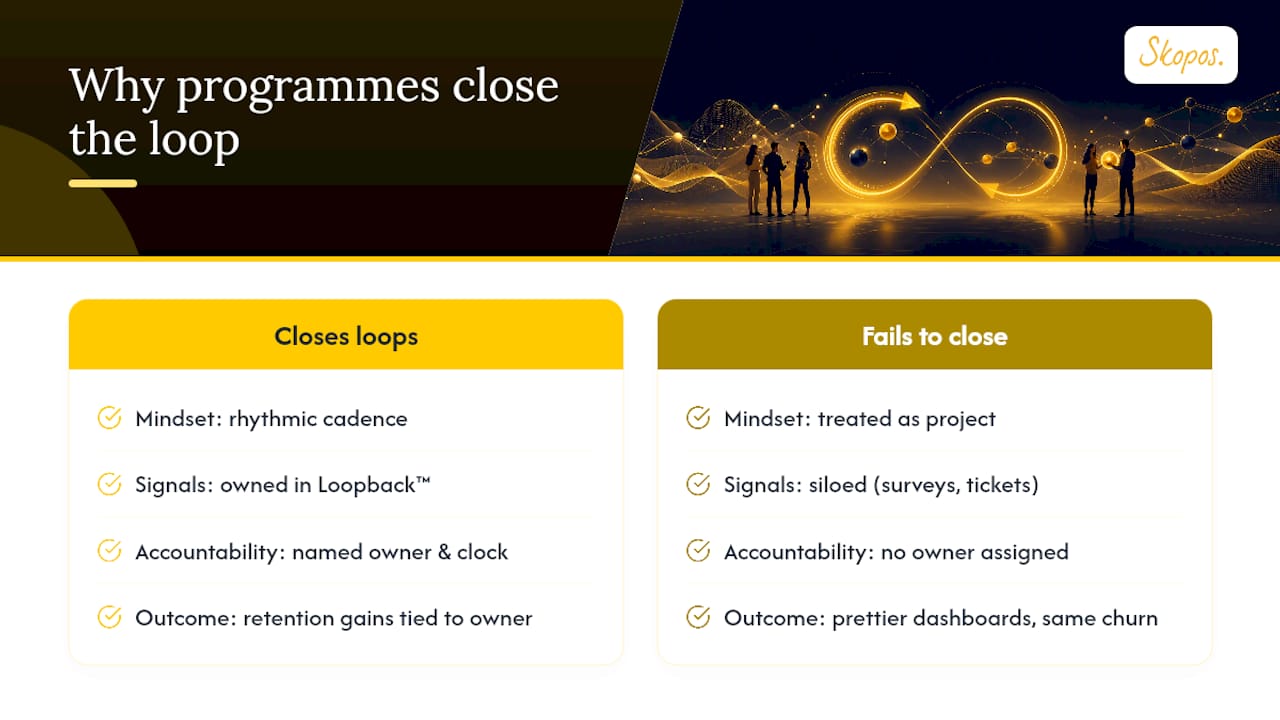
The programmes that work best treat the loop as a rhythm, not a project with an end date. Skopos runs closed-loop CX work through Loopback™, which pulls signal from multiple touchpoints into one owned system rather than leaving surveys, support tickets, and reviews to be reconciled by hand later.
What consistently separates programmes that close loops from those that don’t isn’t tooling sophistication, it’s whether someone with a job title and a clock is accountable for the outer-loop fix. Teams that skip straight to dashboards without fixing ownership end up with better-looking reports and the same churn problem. The churn research that holds up under scrutiny always traces retention gains back to that accountability, not to the survey tool.
Ready to pilot a closed-loop programme?
Skopos runs practical, three-month closed-loop pilots and ongoing voice-of-customer programmes for teams who need proof before they scale, not a slide deck of theory. Where most CX vendors sell you a survey platform and leave ownership to you, Skopos designs the SLAs, routing rules, and conversational follow-up alongside your team, then measures whether the loop actually closed.
If your NPS or CX programme is collecting plenty and acting on little, that’s the exact gap a pilot is built to close. Skopos works on a project basis for a defined pilot or as an ongoing retainer once the model is proven, and the starting point is usually a short scoping conversation about your current customer experience and NPS research setup. Get in touch to talk through what a three-month pilot would look like for your organisation.