October 19, 2026

13
min read
AI for Qualitative Analysis: UK Teams Need a Partner, Not a Coder
Explore how AI supports qualitative research, from thematic analysis to coding reliability, with practical human-in-the-loop workflows and safeguards.

Explore how AI supports qualitative research, from thematic analysis to coding reliability, with practical human-in-the-loop workflows and safeguards.

AI helps you scale and retrieve qualitative data quickly, but only when you treat it as a conversational partner and keep human judgement in charge. Inter-rater reliability, the Data and AI Ethics Framework and our own Skopos practice all point the same way: human-in-the-loop, with people deciding. Below we cover the workflow, the risks, prompt patterns and tool criteria.
Used well, AI takes on the labour that slows a project down and leaves the interpretation to you. Researchers who commission AI-assisted work from us tend to hit the same limits first, so it helps to allocate effort with clear eyes.
Where AI earns its place:
Where it falls short:
LLM-based systems may speed up summarisation, initial code generation and theme extraction, although fully autonomous qualitative analysis remains underdeveloped.
Inter-rater reliability (IRR) is the benchmark we recommend for judging any of this. Treat the AI as one more coder and measure how closely its coding agrees with yours, rather than trusting it because the output reads smoothly.
A 2025 statement signed by over 400 researchers argues that generative AI is methodologically incongruent with reflexive thematic analysis. That warning is aimed at AI as a drop-in replacement for interpretation, which is exactly the use we advise against.
A useful reframing from Susanne Friese is: move from “AI as coder” to AI as interlocutor, a collaborator that provokes and tests your interpretations. Practitioners note that many people treat generative AI as a passive coding assistant, which produces interpretive drift. A deliberate workflow can help guard against that.
Underneath this sits the idea of meta-knowledge. Human-in-the-loop design must be deliberate: humans should quantify uncertainty, direct the AI’s attention to high-potential areas and avoid uncritical reliance on black-box outputs. In practice, ask the model to flag how confident it is in each theme and which segments it found ambiguous. Low confidence or high ambiguity is your trigger for slow, deliberate human review rather than a quick skim.
The same logic appears elsewhere in applied research. Collaborative human and AI frameworks externalise meta-knowledge and use uncertainty signals to trigger human scrutiny, with both sides updated from verified outcomes in iterative cycles. Qualitative work can borrow that structure directly.
Pro Tip: Decide your IRR threshold during planning and write it down. Moving the goalposts after you have seen the AI’s results can mislead you.
Interpretive drift happens when a long chat with a model gradually shapes your reading of the data instead of the data shaping it. Each reply nudges the next question, so you end up refining the AI’s framing rather than testing your own. The related infinite-loop problem is that you can keep iterating with a chatbot indefinitely, with every round sounding more polished and none of them anchored back to a participant’s actual words.
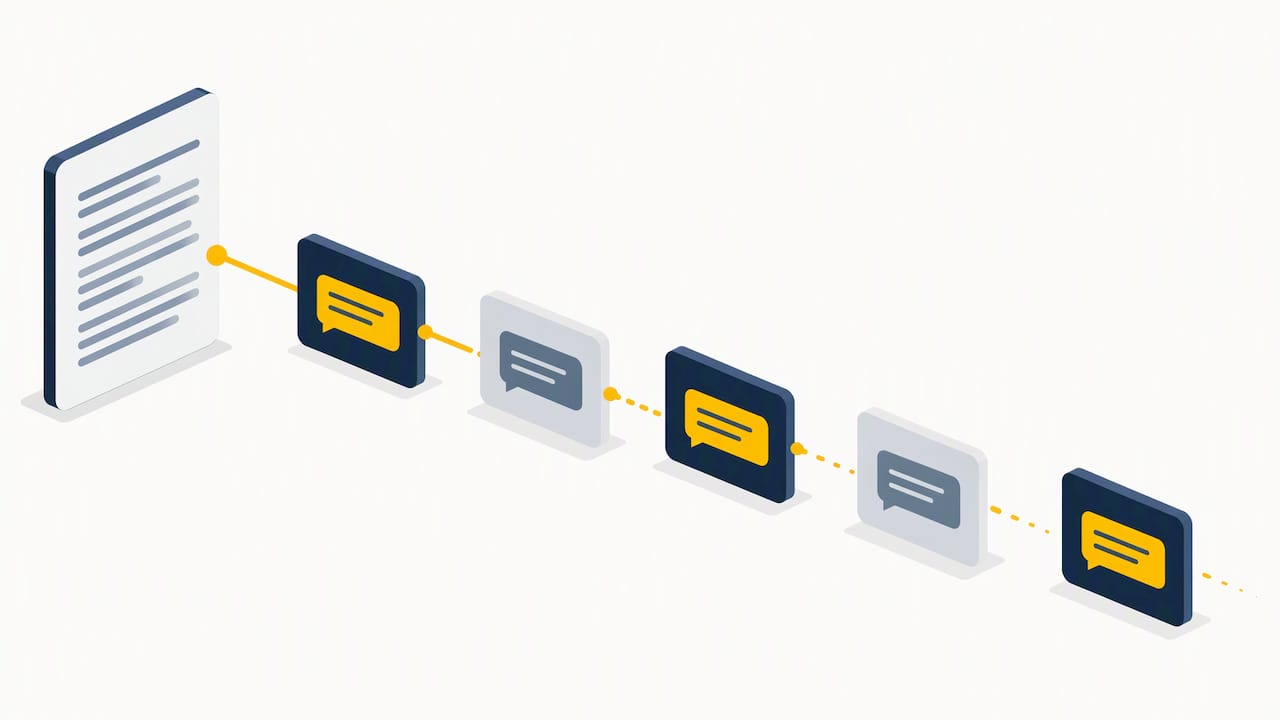
The risk is real because the tool is agreeable and fluent. It rarely says “I don’t know”, and a persuasive paragraph can feel like evidence.
These tactics keep the work honest:
Practitioners warn that treating generative AI as a passive coding assistant can produce interpretive drift, and the remedy they recommend is “coding as conversation”, in which the AI is used to challenge your assumptions.
Run IRR benchmarking regularly. Drift is gradual, and a periodic check against independent human coding is a way to catch it.
For UK work, the Data and AI Ethics Framework is a useful public reference. It asks for transparency, explainability and detailed project documentation, and it encourages outcome-based transparency and records such as model cards and audit logs. Although written for public-sector projects, it is a sensible standard for any commercial or academic researcher.
Large language models introduce specific hazards:
Established organisations manage this with controlled environments. Ipsos UK, for example, has stated it may use large language models within a closed dedicated environment to support transcription and analysis in government research surveys. On the legal side, the Data (Use and Access) Act 2025 includes provisions on automated decision-making and safeguards for research processing, so check how they apply to your project.
Artefacts we recommend you keep:
If your organisation is also deploying conversational AI more widely, independent governance resources such as audit approaches for chatbots can help you think about assurance beyond a single study.
Treat the sequence below as a conversation with escalating scrutiny. Each step narrows the model’s freedom to invent.
On the dos side: give the model a defined scope, ask for provenance every time, and request a confidence rating. On the don’ts side: avoid asking for a single neat narrative, avoid pasting in unrelated data and avoid accepting a theme that cannot be traced to a quote. Asking for a “story” invites spurious synthesis, while asking for evidence protects nuance.
Pro Tip: End every analytical prompt with “If the data does not support this, say so.” It will not stop every error, but it noticeably reduces confident invention.
Think in tool categories rather than brands. A general chat assistant, a dedicated qualitative analysis package with AI features and a bespoke in-house pipeline each suit different projects. Established qualitative software remains well documented, and the University of Surrey’s overview of computer-assisted qualitative data analysis is a helpful starting point for understanding what that category already does.
Evaluate each option on these axes:
Run a short pilot before committing. Code the same small sample with and without the tool, then collect IRR, time saved and the types of error you see.
Pilot cycles of this kind are a familiar idea in analyst work, and short proof cycles are a practical way to test a workflow before scaling it.
The evidence is divided, and a balanced approach is one possible path:
Our recommendations follow from all three.
Most researchers will not train a model from scratch. They will adapt prompts, supply examples or fine-tune a tool on their own material. The principles are the same either way.
Start with the codebook. A model learns far more from a code with a clear definition, inclusion and exclusion rules and two or three annotated examples than from a bare label. Include borderline cases, because those teach the model where the edges are.
Use data that fits the purpose. Training or example material should resemble what the model will analyse, in language, context and participant type. A codebook built on interviews from one market may transfer badly to another.
Separate your sets. Keep a portion of human-coded data aside to test the model, and never evaluate it on examples it has already seen. This is where IRR earns its keep, since agreement on unseen data is the number that matters.
Protect participants. Remove names and identifying details before data goes near an external service, check the provider’s retention terms and prefer closed environments for sensitive material.
Finally, document what you did: the examples used, the versions of the tool and the changes you made. Documentation is what lets another researcher judge your results, and it is what the Data and AI Ethics Framework asks of any serious project.
Bias can enter at three points: the data a model was built on, the examples you give it and the way you read its output. Language models tend to reflect the dominant voices in their training material, so accents, dialects, minority viewpoints and unconventional phrasing can be flattened or misread.
In practice that means checking whether the model treats different participant groups consistently. Code a sample from under-represented groups by hand and compare the AI’s output with it. If agreement drops for one group, you have found a bias worth correcting before it shapes your findings.
Some habits help:
Bias also affects how people react to AI output. A fluent paragraph is easy to believe, so the discipline of provenance and uncertainty checks matters as much here as it does for hallucination. The goal is not a bias-free model, which does not exist, but a process that makes bias visible and correctable.
AI works best as a layer on top of established methods and not as a substitute for them. Thematic analysis, grounded theory and framework analysis all depend on a researcher moving closely through the data, and that immersion should stay yours.
A sensible pattern is to read first. Spend time with a subset of transcripts before asking the AI anything, so you form your own impressions. Then use the model to test them: does it find the same patterns, does it find others and where does it disagree?
Use AI for the heavy lifting around the edges. It is well suited to pulling together every passage on a topic across a large dataset, producing a first summary for you to correct or checking that a theme you built from an initial set of interviews also appears in the rest of the dataset. The deeper work of naming a theme, deciding what it means and linking it to theory stays with you.
Computer-assisted qualitative analysis has long supported researchers in organising and retrieving data, and AI features extend that tradition rather than replace it. For a broader view of how this fits into wider insight work, our overview of the role of AI in market research discusses the topic, and our piece on humans and AI in insight covers the collaboration itself. Where you are gathering data online, our notes on online qualitative and digital dialogues show how remote methods feed these workflows.
Several directions look likely, though none is settled.
AI-assisted probing is one. Rather than analysing data after the fact, tools are beginning to follow up with participants during a session, asking a clarifying question when an answer is thin. We use this idea in our own Deepr™ open-ended probing tool, always with a researcher setting the line of questioning.
Better uncertainty reporting is another. As the literature on human-in-the-loop design matures, expect tools to expose how confident they are in each output and to route doubtful cases to a person automatically.
Governance will tighten. Frameworks such as the Data and AI Ethics Framework and the provisions of the Data (Use and Access) Act 2025 signal that documentation, transparency and audit trails will become expected practice and not optional extras.
Benchmarking will become routine. With reported research-grade agreement for well-specified codes, buyers will increasingly ask for IRR evidence before accepting an AI-assisted result.
The sceptics’ concerns will also persist, and rightly. The likely outcome is not a victory for either camp but a settled practice in which AI handles scale and retrieval while people handle meaning.
At Skopos we use AI to move faster on retrieval, summarisation and first-pass theming, and we do not let it make the interpretive calls. Every theme we report traces back to participant words and a researcher’s judgement. In practice, a well-governed pilot can give clients usable direction sooner without any loss of rigour.
If you want AI-assisted qualitative work that stands up to scrutiny, we design bespoke studies with governance built in, from prompt logging to audit-ready reporting. To explore a pilot or a longer engagement, look at our insight partner options or contact us through our services page.
No. AI can speed up retrieval, summarisation and first-pass theme suggestion, but a 2025 researcher statement argues generative AI is methodologically incongruent with reflexive analysis. Treat it as a collaborator and keep interpretation with the researcher.
Use inter-rater reliability. Have human coders independently code a sample, then compare their agreement with the AI’s coding. Benchmarking work reports that LLM-assisted tools can reach a Cohen’s kappa of about 0.7 for well-specified codes.
It depends on the deployment. Remove identifying details first, check how the provider retains data and prefer closed environments for sensitive material. The Data and AI Ethics Framework recommends keeping records such as model cards and audit logs.
It means using AI as a conversational partner that challenges your interpretations instead of coding data for you. Susanne Friese describes this shift as moving from coder to interlocutor, with the researcher staying in charge.