
June 16, 2026

8
min read
The role of AI in market research: 2026 guide
A practical guide to how AI is changing market research, where it adds value, and where human judgement still matters.

A practical guide to how AI is changing market research, where it adds value, and where human judgement still matters.

Artificial intelligence in market research is defined as the application of machine learning, natural language processing, and predictive modelling to automate data collection, analysis, and consumer insight generation. The role of AI in market research has shifted from experimental to operational: firms like Cashew Research, Leger Marketing, and platforms such as AIMI are compressing research cycles that once took months into a matter of days. AI now handles tasks from synthetic persona creation to real-time social listening, freeing researchers to focus on interpretation rather than data processing. For marketing professionals, this shift changes not just speed and cost, but the depth and frequency of insight available.
AI applications in market research fall into five distinct categories, each replacing or augmenting a traditional research method.
Pro Tip: When deploying NLP for open-ended survey analysis, train your model on sector-specific vocabulary first. Generic language models frequently misclassify industry terms, which distorts thematic coding and skews your findings.
The practical effect of these tools is that artificial intelligence market analysis moves from a retrospective exercise to a forward-looking one. You are no longer only describing what happened last quarter. You are modelling what is likely to happen next.

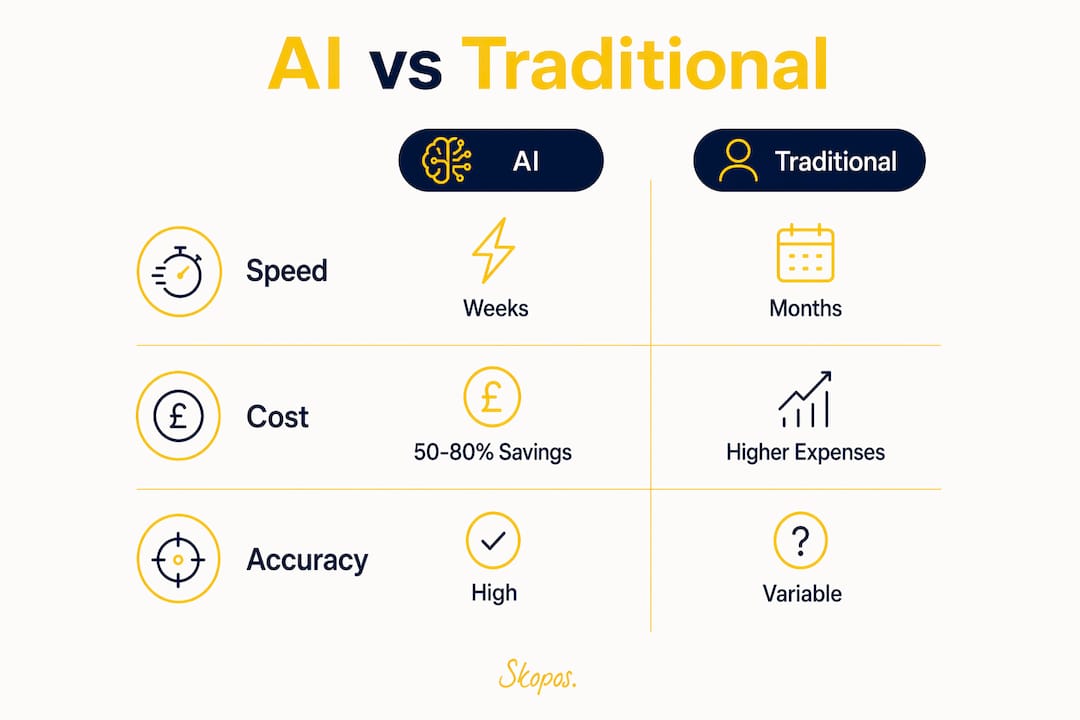
The performance gap between AI-assisted and traditional market research is measurable and significant. The table below summarises the key differences.
The cost reduction figure deserves context. A 50–80% saving does not come from cutting corners. It comes from automating transcription, data cleaning, and initial coding, which are tasks that previously consumed the majority of a researcher’s billable hours. AI frees researchers from manual workload so they can concentrate on strategic interpretation.
Timeline compression is equally significant. Research timelines shortened by five to six weeks are now common across many study types. For a brand planning a product launch or responding to a competitive threat, that time saving is commercially material.
AI also enables scale that was previously impractical. Running simultaneous studies across multiple markets, languages, or customer segments is no longer a resource constraint. Skopos uses this capability to deliver multi-market research without sacrificing comparability across geographies.
AI is a force multiplier for research teams. It is not a replacement for researcher judgement, and treating it as one produces unreliable results.
The most significant limitation is the boundary of historical data. Synthetic panels are less effective for radically innovative products where no comparable historical data exists. If you are testing a genuinely new category, the model has nothing meaningful to learn from. Traditional qualitative research remains the more reliable method in those cases.
A second risk is generic output. AI synthesis tools, when left unchecked, tend to produce findings that reflect the average of their training data. Human researchers must pressure-test AI-generated themes to confirm thematic saturation and avoid under-sampled conclusions. The Parallel Running Pattern addresses this directly by comparing AI outputs against traditional results before decommissioning legacy methods.
There are also data quality risks specific to AI-moderated studies:
The AI impact on market research is real and substantial. The risks above are manageable with proper design and oversight. They are not reasons to avoid AI. They are reasons to use it thoughtfully.
Effective AI adoption in market research follows a structured sequence. Jumping straight to full automation without validation creates more problems than it solves
Industry leaders view AI as a transformative aid that accelerates insight generation without replacing human judgement. That framing is the right one. The goal is not to remove researchers from the process. The goal is to remove the parts of the process that do not require a researcher.
For teams working across markets, this integration approach also applies to market research in Europe, where regulatory and cultural variation makes human oversight particularly important.
AI in market research delivers the greatest value when it automates data processing and frees human researchers to focus on strategic interpretation and commercial judgement.
I have watched the conversation around AI in research shift considerably over the past two years. Early on, the dominant question was whether AI would replace researchers. That question has largely been answered. It will not. The more useful question now is which parts of the research process AI should own, and which parts it should support.
My view is that the industry has been too slow to distinguish between these two things. Teams either resist AI entirely, citing quality concerns, or they automate too aggressively and end up with fast results that lack the interpretive depth clients actually need. Neither extreme serves the client well.
What I have seen work is a disciplined, incremental approach. Start with the tasks that are genuinely mechanical: transcription, coding, data cleaning, sentiment classification. Let AI handle those. Then apply human expertise where it genuinely matters: framing the right questions, interpreting ambiguous findings, and connecting research outputs to commercial decisions.
The researchers who thrive in this environment are not the ones who resist AI. They are the ones who understand it well enough to know when to trust it and when to push back. That skill is worth developing now, because the tools will only become more capable. The judgement required to use them well will remain a human responsibility.
If you want to see what clients are asking for in 2025 and beyond, the pattern is consistent: faster turnaround, greater depth, and clearer commercial relevance. AI makes all three more achievable. But only when it is applied with the right expertise behind it.
Skopos combines human expertise with carefully applied AI to deliver research that is faster, deeper, and directly connected to commercial decisions.
Whether you need customer segmentation powered by AI-driven behavioural analysis, concept and product testing that uses synthetic panels to accelerate innovation cycles, or custom research services designed around your specific business questions, Skopos builds programmes that combine the speed of AI with the rigour of expert human oversight. Our work spans the UK, Europe, and international markets, with sector experience across financial services, consumer brands, technology, and retail. If you are ready to move from periodic insight to continuous intelligence, speak to the Skopos team about what an AI-enhanced research programme could look like for your organisation.
AI in market research automates data collection, analysis, and consumer insight generation through tools including NLP, synthetic panels, and predictive modelling. Its primary role is to accelerate and deepen the research process while freeing human researchers for strategic interpretation.
Synthetic consumer panels trained on historical data predict consumer choices with up to 92% accuracy after fine-tuning. Accuracy is highest for iterative use cases such as pricing, naming, and marketing claims, and lower for genuinely novel product categories.
AI is most effective as a complement to traditional methods, not a replacement. Synthetic data excels in iterative, lower-risk scenarios but lacks robustness for high-risk, entirely new product concepts that have no historical data to draw from.
AI-enabled research can be 50–80% cheaper than traditional methods. The saving comes primarily from automating transcription, coding, and data cleaning rather than from reducing sample sizes or research scope.
The recommended starting point is AI-powered social listening, which delivers immediate value without disrupting existing workflows. From there, adopt the Parallel Running Pattern: run AI and traditional methods simultaneously for one full cycle to validate outputs before scaling further.