

August 10, 2026

9
min read
What is consumer attitude research? A guide for marketers
Learn how consumer attitude research uses the ABC model, Fishbein, TRA and TPB to measure beliefs, feelings and intentions—and turn insight into brand strategy.

Learn how consumer attitude research uses the ABC model, Fishbein, TRA and TPB to measure beliefs, feelings and intentions—and turn insight into brand strategy.

Consumer attitude research is defined as the formal study of an individual’s relatively enduring evaluation of a brand, product, or service, structured around the ABC model comprising affective, cognitive, and conative components. The standard industry term is “consumer attitude research,” though practitioners also refer to it as consumer behaviour analysis or attitude measurement. Understanding how feelings, beliefs, and intentions combine gives marketing professionals a direct line to predicting purchase decisions before they happen. For brand strategists and business analysts, this discipline is not optional background reading. It is the foundation of every positioning, segmentation, and messaging decision that holds up under scrutiny.
Consumer attitude research measures three distinct psychological layers that together shape how a person responds to a brand. The ABC model names these as affective (emotional feelings toward a brand), cognitive (beliefs and knowledge about it), and conative (intention to act or purchase). Each layer contributes differently to the final decision. A consumer may believe a product is high quality (cognitive) but feel indifferent toward the brand (affective), which suppresses purchase intent (conative) despite a technically strong product.
The importance of consumer research lies in this granularity. Aggregate sales data tells you what happened. Attitude research tells you why, and more usefully, what is likely to happen next. Brands that track attitudes over time can detect shifts in perception before they show up in revenue figures. That early warning function alone justifies the investment for most marketing teams.

Attitude research also informs brand tracking programmes, where repeated measurement across time reveals whether campaigns are moving the right psychological levers. A campaign that lifts awareness but leaves affective scores unchanged has not done its job, and attitude data makes that visible.
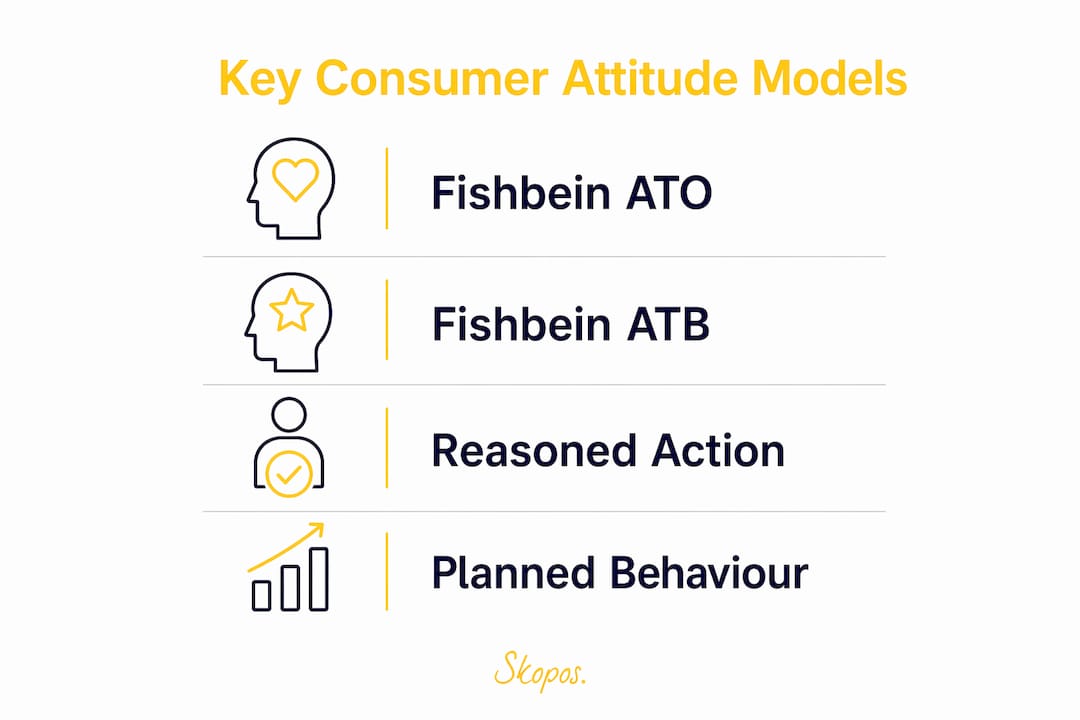
Several theoretical models structure how researchers measure and interpret consumer attitudes. Each model offers a different level of precision and a different application context.
Fishbein’s Attitude Toward the Object (ATO) model evaluates a consumer’s overall attitude by multiplying their belief strength about each product attribute by their evaluation of that attribute, then summing the results. It is well suited to product comparison research because it quantifies which attributes drive overall attitude most strongly.
Fishbein’s Attitude Toward the Behaviour (ATB) model shifts focus from the product itself to the act of purchasing it. This distinction matters because a consumer can hold a positive attitude toward a product but a negative attitude toward buying it, perhaps due to price, availability, or social context.
The Theory of Reasoned Action (TRA) extends the ATB model by adding subjective norms, recognising that social pressure influences whether intentions translate into behaviour. Multi-attribute models use belief and evaluation scores to quantify attitudes and predict behaviour with greater accuracy than single-item measures.
The Theory of Planned Behaviour (TPB) adds a third variable: perceived behavioural control. This acknowledges that even willing consumers may not act if they feel unable to do so, due to cost, access, or confidence. Perceived behavioural control improves the prediction of actual behaviour beyond what attitudes and norms alone can explain.
Pro Tip: Use the TPB model when researching categories where consumers face real or perceived barriers to purchase, such as electric vehicles, financial products, or premium goods. Ignoring perceived control produces optimistic attitude scores that never convert.
Effective study design starts with separating the three constructs that researchers most commonly conflate: attributes, beliefs, and attitudes. Attributes are observable product features, beliefs are subjective perceptions about those features, and attitudes are the overall predispositions formed from accumulated beliefs. Mixing these in a single survey question produces data that cannot be acted upon.
The most reliable attitude measurement techniques include:
Measuring attitudes accurately requires combining quantitative tools with qualitative research. Quantitative data gives you scale; qualitative data gives you meaning. Neither alone is sufficient for strategic decisions.
Pro Tip: Write separate survey questions for each ABC component. A question like “How do you feel about Brand X?” conflates affective and cognitive responses. Instead, ask “How would you describe your emotional reaction to Brand X?” and “How strongly do you believe Brand X offers good value?” as distinct items.
The attitude-behaviour gap is the persistent discrepancy between what consumers say they will do and what they actually do. Positive consumer attitudes do not always translate into actual purchases, and this gap is one of the most consequential challenges in consumer behaviour analysis.
Green product research illustrates the gap clearly. Consumers consistently report strong positive attitudes toward sustainable products. Purchase rates for those same products remain far lower than attitude scores would predict. Social desirability bias, price sensitivity, and habit all suppress conversion from intention to action.
Several factors widen the gap:
Combining attitude data with behavioural indicators such as sales figures, click-stream data, or loyalty programme records addresses the gap directly. This triangulation produces a fuller picture of consumer decision-making and improves the validity of marketing decisions. Attitude data without behavioural context is a hypothesis. Attitude data alongside behavioural data is evidence.
Consumer attitude research feeds directly into four strategic marketing decisions: segmentation, positioning, messaging, and product development. Specific attitudes revealed by research inform all of these, making attitude data one of the most commercially versatile outputs a research programme can produce.
Integrating qualitative and quantitative research produces the richest insight. Qualitative work surfaces the language and emotional associations consumers use. Quantitative work scales those findings across a representative sample. Together, they give marketing teams both the “what” and the “why” needed for confident decisions. Skopos’s custom research services are built around this integrated approach.
Consumer attitude research is most useful when it separates affective, cognitive, and conative components and combines attitude data with behavioural evidence to close the gap between stated intent and actual purchase.
Consumer attitude research is one of the most misused tools in the marketing research toolkit. The problem is not the models. The problem is that most teams treat attitude surveys as a proxy for behaviour prediction, then feel let down when the data does not deliver.
I have reviewed a lot of attitude studies where the survey design conflated beliefs and feelings in the same question. The result is a score that looks meaningful but cannot tell you whether to change the product, the message, or the price. That is not a data problem. That is a design problem, and it is entirely avoidable.
The attitude-behaviour gap frustrates researchers who expect attitude scores to predict sales directly. They rarely do on their own. The teams that get the most value from attitude research are the ones who treat it as one layer of evidence, not the whole picture. They pair attitude data with what clients actually need from research: clear commercial recommendations, not just scores.
The other underappreciated issue is that attitudes are not static. A brand’s affective scores can shift meaningfully within a single quarter following a product recall, a competitor campaign, or a cultural moment. Research programmes that measure attitudes annually miss the dynamics that matter most to brand managers. Quarterly or continuous tracking, even at lighter sample sizes, is more useful than a single deep study every 18 months.
The future of attitude research lies in combining traditional survey methods with passive behavioural data. That combination closes the gap between what people say and what they do, and it is where the most commercially useful insight now lives.
Skopos designs consumer attitude research programmes that separate affective, cognitive, and conative components from the outset, so clients receive data they can act on rather than scores they need to interpret. Whether the brief calls for a one-off attitude study or a continuous brand tracking programme, Skopos combines qualitative depth with quantitative scale to produce findings that hold up commercially.
For marketing teams and business analysts who need sharper insight into how consumers think, feel, and intend to behave, Skopos’s UK market research services cover the full range of attitude measurement techniques, from Likert-based surveys and conjoint analysis to in-depth qualitative research. The result is insight that moves from “what do consumers think?” to “what should we do about it?”
Consumer attitude research is the formal study of how individuals evaluate a brand, product, or service using the ABC model: affective (feelings), cognitive (beliefs), and conative (intentions) components. It predicts purchase behaviour and informs brand strategy.
The main techniques are Likert scales, semantic differential scales, conjoint analysis, and qualitative methods such as depth interviews. Combining quantitative and qualitative tools produces the most reliable and commercially useful findings.
The attitude-behaviour gap occurs when positive attitudes fail to convert into purchases, driven by social norms, situational constraints such as price or availability, and low perceived behavioural control. Integrating behavioural data with attitude scores reduces the gap’s impact on decision-making.
The ABC model directs researchers to write separate questions for feelings, beliefs, and intentions rather than combining them. This separation produces cleaner data and makes it possible to identify which component needs to change to influence consumer behaviour.
Businesses use attitude data for segmentation by attitude profile, brand positioning, message calibration, and product development prioritisation. Repeated measurement through brand tracking programmes shows whether marketing investments are shifting the right psychological components over time.