

August 24, 2026

8
min read
Why CX research drives revenue: a leader's guide
Discover how CX research drives revenue through retention, CLV, cross-sell, price premium and operational efficiency — and how to build a focused CX research pilot.

Discover how CX research drives revenue through retention, CLV, cross-sell, price premium and operational efficiency — and how to build a focused CX research pilot.

CX research drives revenue by improving four financial levers: customer retention, lifetime value, cross-sell and upsell rates, and the price premium customers will pay for a better experience. It also cuts cost to serve by finding friction before it becomes a support ticket. McKinsey’s analysis found that a single moment of customer delight can lift loyalty for a sustained period and materially increase cross-sell and upsell rates. If you sponsor one thing this quarter, make it a focused CX research sprint on your highest-value customer journey, not another dashboard.
CX research drives revenue when it is scoped against a specific commercial KPI, funded as a recurring programme, and owned by someone accountable for the outcome.
CX research earns its budget by pointing at specific, ownable levers rather than a vague promise of “happier customers”. Each mechanism below has a distinct measurement path, which matters when you’re building a case for the board.
Here’s how the chain actually works in practice. A behavioural research study on checkout abandonment might surface that customers distrust a delivery estimate, not the price. Fix the estimate’s wording and specificity, and conversion moves without touching the product or the cost base. That’s the difference between research-led action and a guess dressed up as a “redesign”.
SuperOffice’s synthesis of customer-centric performance data points to a consistent pattern: companies that prioritise CX report stronger profitability and faster revenue growth than peers who treat service as a cost centre, without specifying precise percentages.
Pro Tip: Map each research finding to one specific KPI before you commission the project, not after. If a finding can’t be tied to retention, CLV, cross-sell, price premium or cost-to-serve, it’s interesting but it isn’t a business case.
An event-study analysis of 35 corporations found that well-executed CX initiatives can produce real increases in customer lifetime value, loyalty and brand equity. The same study is candid about variability: outcomes depend heavily on whether the initiative genuinely aligns with customer needs and whether execution matches the ambition. A good idea poorly delivered doesn’t move revenue.
The named examples in that research are useful because they’re recognisable. Starbucks’ expansion of its digital loyalty programme, McDonald’s investment in digital ordering, and Ford’s platform-level customer initiatives all appear as cases where CX investment translated into measurable engagement and financial results. None of these were single fixes. Each combined a customer insight with a sustained operational change.
That caveat matters more than the headline. Industry reports occasionally cite eye-catching figures such as a 301% ROI for some CX programmes, but treat these as upper-bound examples rather than typical outcomes. The event-study’s own finding, that success hinges on alignment and execution, is the more reliable planning assumption.
The event-study behind the corporate examples above also sets out five principles that separate CX programmes that pay for themselves from ones that don’t.
Pro Tip: Spend at least a third of your research budget hunting for delight moments to scale, not just pain points to fix. McKinsey’s delight research found this is where the disproportionate revenue gains sit, as delight has a compounded effect on referrals and cross-sell beyond what pain-point removal typically achieves.
You don’t need a twelve-month transformation programme to prove this works. You need one well-scoped question, a mixed-method approach, and a governance structure that gets findings in front of someone who can act on them.
Tie the programme to metrics finance will recognise:
A pragmatic pilot can run lean: a focused qualitative and behavioural study on one journey, delivered in four to six weeks, is enough to generate a defensible business case. Perspective AI’s analysis of 2026 research spending found that CMOs who moved to leaner, AI-enabled in-house research cut per-programme costs substantially and compressed time-to-insight considerably. You don’t need the largest budget to move fast; you need the right scope and a sponsor who owns the outcome. That sponsor should be commercially accountable, ideally someone who reports to the CFO or sits on the executive committee, because the strongest business cases compare research cost against the cost of post-launch rework, not against doing nothing.
Most failures aren’t about bad research. They’re about what happens after the findings land.
Pro Tip: If your CSAT score moves but revenue doesn’t, that’s a signal to bring in UX research methods like behavioural observation and prototype testing. Zendesk’s practitioner guidance argues this is exactly how teams uncover the “why” behind a metric, rather than reacting to the number itself.
Across engagements where research links directly to a commercial decision, retention and cross-sell metrics move fastest when the client’s own team owns the follow-through, not just the findings. Skopos works human-led and AI-disciplined, meaning modern tools speed up analysis without losing the judgement that turns a finding into a decision, across sectors from financial services to retail and technology.
If you’ve read this far, you already know the theory. The harder part is choosing a first project that proves the case without a six-month wait. Skopos runs focused CX and UX and user journey research alongside customer segmentation and brand tracking, all built to answer one commercial question at a time rather than produce a report that sits unread.
A sensible first engagement is a four to six week pilot focused on one revenue-relevant journey, such as renewal, onboarding, or a high-value cross-sell moment. In that pilot, Skopos will typically deliver:
Get in touch through the UK market research team to scope a pilot around the revenue question that matters most to your business this quarter.
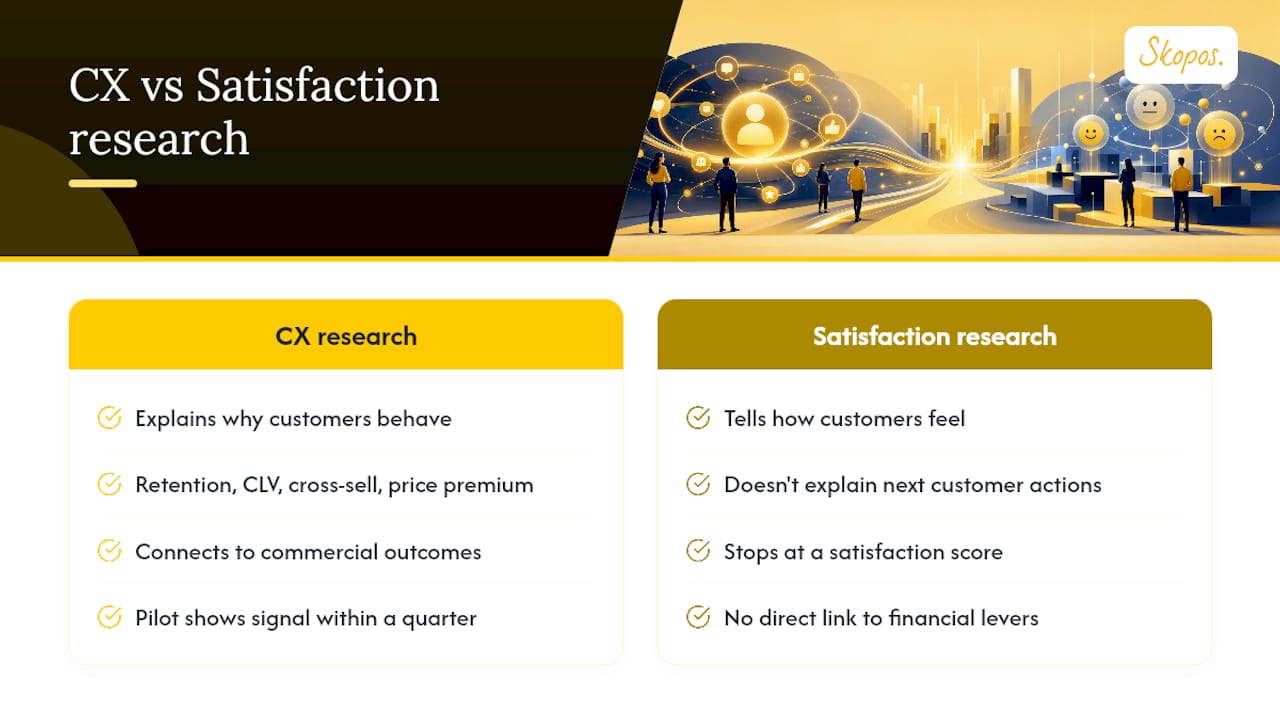
Why does CX research drive revenue rather than just satisfaction scores? Because it links directly to financial mechanisms, retention, CLV, cross-sell and price premium, rather than stopping at a satisfaction score that doesn't, on its own, explain what customers will do next.
How quickly can a CX research programme show financial impact? A focused pilot on one journey can show measurable signal within a quarter, particularly when it's tied to a metric you were already tracking, such as conversion or retention on that specific journey.
What's the difference between CX research and customer satisfaction research value?Satisfaction research tells you how customers feel; CX research explains why, and connects that explanation to a specific commercial outcome you can act on.
Do small businesses see the same benefits of customer experience research as large corporations? The mechanisms, retention, CLV, cross-sell, are the same regardless of size. Smaller organisations often see faster payback because a single well-targeted intervention affects a larger share of total revenue.
Is CX research and profitability link stronger in certain sectors? Evidence spans sectors from retail to financial services, though the specific lever that matters most, price premium versus retention versus cross-sell, varies by business model and customer relationship length.