

August 27, 2026

11
min read
Research debrief for stakeholders: a 30-minute workflow
Learn how to run a stakeholder research debrief that turns findings into action, with 3–5 key insights, clear evidence, named owners and next steps.

Learn how to run a stakeholder research debrief that turns findings into action, with 3–5 key insights, clear evidence, named owners and next steps.

Share a one-screen executive summary with 3 to 5 headline findings, then run a 30-minute readout that ends with named owners. That single move fixes most of what goes wrong when research findings never turn into decisions.
The recommended output is simple: one page your stakeholders can read in under two minutes, sitting on top of a live report they can click into for evidence. Send it asynchronously first. Then book a short readout where the only job is to assign owners to what happens next.
Before the session, check your summary includes:
A stakeholder debrief succeeds when it leads with a one-screen recommendation, limits headline findings to 3 to 5, and closes every session with named owners and dates.
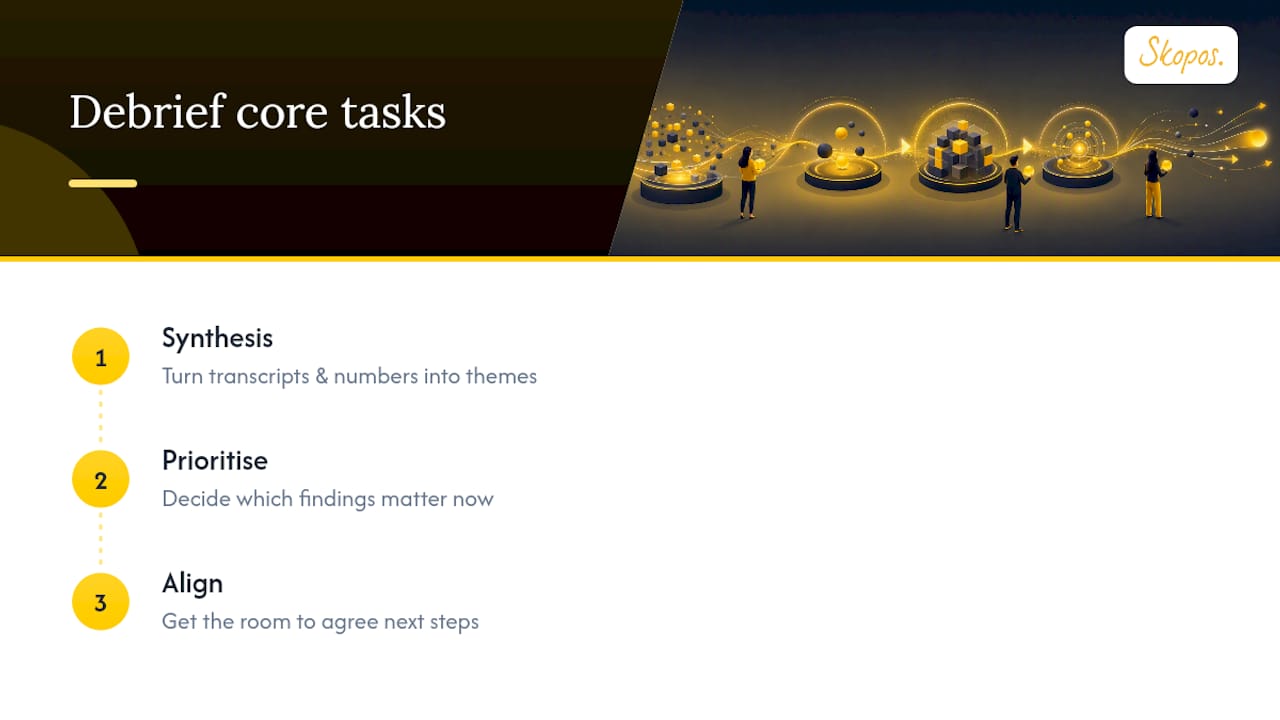
A research debrief is a structured event, or a document, that converts raw research data into decisions stakeholders can act on. It does three jobs: synthesis (turning transcripts and numbers into themes), prioritisation (deciding which findings matter most right now), and alignment (getting the room to agree on what happens next).
Not every debrief looks the same, and confusing the two formats is where a lot of research impact gets lost.
Internal team debrief. This is working and exploratory. Researchers, designers, and analysts pull apart the data, argue over interpretation, and stress-test conclusions before anything reaches a stakeholder’s inbox. Discussion is welcome here. Messiness is fine.
Stakeholder readout. This is polished and decision-focused. By the time stakeholders see it, the debate has already happened. The readout presents a recommendation, the evidence behind it, and a clear ask.
Run the internal version within a day or two of fieldwork closing, while the detail is fresh. Run the stakeholder version once your team has converged on a recommendation, typically within a week. Skipping the internal debrief and taking raw findings straight to stakeholders is a common shortcut that usually backfires, because unresolved disagreements surface live in front of the people you need to convince.
The instinct to invite everyone with a stake in the project is understandable and almost always wrong. A stakeholder readout works best with decision-makers in the room, plus one representative from each function the findings touch, product, marketing, customer experience, and so on. Ten people arguing rarely reaches a decision; four or five with authority usually does.
Three roles make or break the session:
For politically sensitive projects, or research that touches a function’s own performance, bring in a neutral third-party facilitator. Removing the person with a stake in the outcome from the facilitator’s chair takes the emotion out of the room and keeps the conversation on decisions rather than defensiveness.
Pro Tip: If two departments disagree on what a finding means, that’s exactly the moment to hand facilitation to someone outside both teams. Internal facilitators, however experienced, struggle to stay neutral once their own department’s assumptions are being challenged.
A stakeholder readout runs best inside a fixed 30 to 45 minute window. Open it up beyond that and discussion sprawls, decisions get deferred, and you’re back where you started. The section below gives you a structure you can copy directly into your next meeting invite.
That last point matters more than most teams give it credit for. Structured templates that cap headline findings at 3 to 5 measurably improve how much stakeholders retain and how confidently they act on it, compared with a 20-slide deck that buries the real story.
Three deliverables should leave the room with every attendee: the one-screen executive summary, a named owner against every recommendation, and a link to the full evidence trail and appendix for anyone who wants to dig deeper later.
How you represent confidence and effort matters as much as the findings themselves. A simple two-axis label does the job without overcomplicating the readout:
Pair that with an effort estimate, quick, moderate, or significant build, so stakeholders can weigh confidence against cost when they choose what to prioritise first.
The work that makes a 30-minute readout possible happens in the days before it, not during it. Build the executive summary first, because everything else in the session hangs off it.
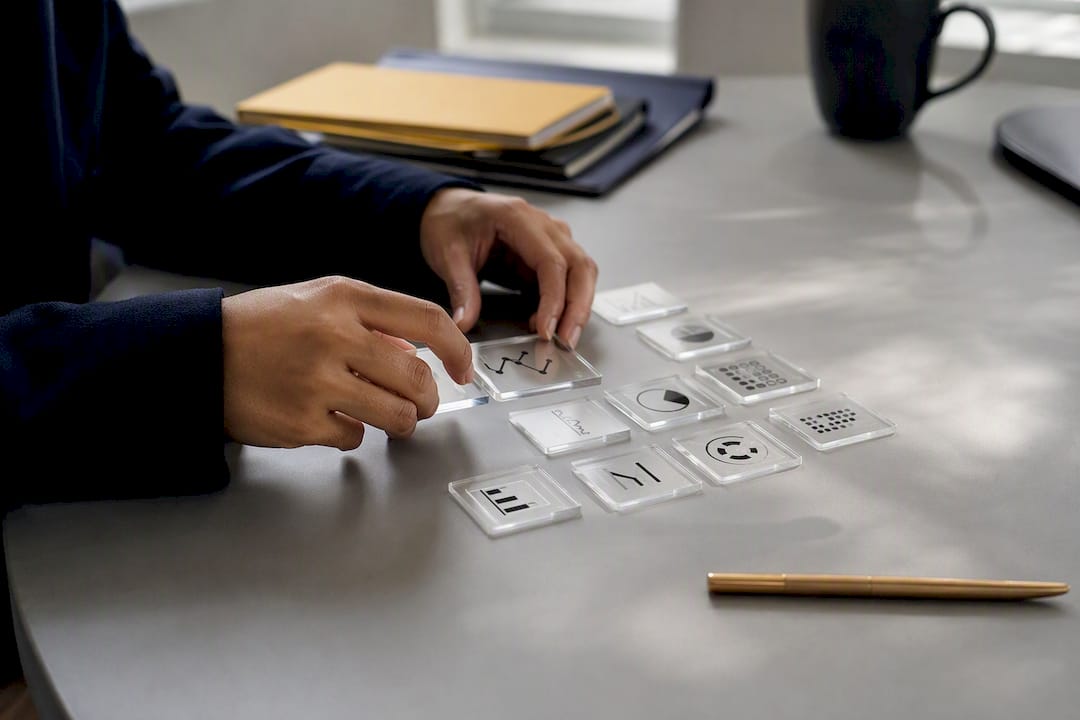
Structure it around four elements: one top-line metric (the headline finding), one supporting metric (evidence that reinforces it), one context metric (how it compares to a benchmark, a previous wave, or a target), and one chart that makes all three visible at a glance. This is the exact structure UX research communication guidance recommends for executive audiences, and it works because it forces you to decide what actually matters before anyone else sees the data.
Pro Tip: Send the executive summary at least 24 hours before the readout. Stakeholders who’ve already seen the headline arrive ready to discuss implications, not to read the slide for the first time live.
Publish it as a live, web-based report rather than a static PDF. A PDF goes stale the moment someone asks a follow-up question; a live report stays current, lets you drop in new evidence as it emerges, and shows you who has actually opened it. Select two or three representative quotes that capture the finding in a participant’s own words, and link the raw transcripts or data tables in an appendix, so anyone who questions a conclusion can check the source themselves.
Open by restating the decision question, in one sentence, before you show a single slide. Follow it immediately with the headline recommendation. Everything else in the room exists to support or challenge that one sentence, and naming it first stops the conversation drifting into “interesting, but so what?” territory.
From there, move through findings fast: headline, evidence, implication, repeat. Resist the urge to walk through every chart in the deck. If a stakeholder wants more detail on a specific finding, that’s what the evidence trail and appendix are for.
That fourth step is where most debriefs quietly fail. Teams present beautifully, then let the meeting end on “let’s take this away and think about it.” Close instead with a decision prompt for every recommendation: who owns it, what happens by when, and what confidence level it carries. Write the owner’s name down in the room, out loud, before anyone leaves.
Pro Tip: If a decision can’t be made in the room, don’t let it disappear into “we’ll follow up.” Name a date for the follow-up decision itself, and assign someone to chase it.
Distribution isn’t an afterthought bolted onto the end of a debrief. It’s the mechanism that decides whether findings ripple through an organisation or die in one meeting room.
Send the executive summary asynchronously first, ideally a day ahead of any live session, so people arrive briefed rather than blindsided. Reserve the live readout for decisions, not first exposure to the data.
A short methodology appendix with links to raw data consistently improves how much stakeholders trust a finding, because it gives sceptics a way to check the work rather than take it on faith.
Three templates cover most of what a research team needs to standardise its stakeholder communication without reinventing the format every project.
The debrief email. Keep it to five short parts: a one-line headline, 3 to 5 signals (bulleted, plain language), one or two supporting quotes, a link to the full report, and 3 to 4 specific validation questions. A stakeholder-friendly debrief email works best when observations are clearly separated from interpretation, and when the closing questions ask for something concrete: “Does this match what your team is seeing in support tickets?” rather than “Any thoughts?”
The 15-minute readout checklist.
The slide skeleton. One summary slide up front. One slide per headline finding, each following the headline, evidence, implication structure. Everything else, full data tables, methodology notes, extended quotes, moves to appendix slides that stay in the deck but never get presented live unless someone asks.
Most debrief failures trace back to a handful of repeatable errors, and each one has a straightforward fix.
Skopos runs on a human-led, AI-disciplined model: research teams do the interpretation, judgement, and stakeholder framing, while tools sharpen the process without replacing it. Deepr™, Skopos’s proprietary probing tool, digs deeper into open-ended responses than a standard survey question allows, surfacing the “why” behind a stated preference before it ever reaches a debrief slide.
That combination shows up across the engagement types Skopos runs most often:
If your team is deciding whether to build this process internally or bring in support, a short audit of your last debrief, or a sample debrief run on an existing dataset, is a low-risk way to see the difference a structured approach makes.
The conventional advice on stakeholder debriefs focuses almost entirely on the deck, more slides, better charts, tighter storytelling. That’s not where most debriefs actually fail. They fail in the room, when nobody names an owner and the meeting ends on “let’s regroup on this.”
A 20-slide deck with beautiful data visualisation and zero named owners has delivered nothing. A rough one-pager with three findings and four assigned actions has delivered everything a debrief exists to produce. Research teams chronically underrate the facilitation half of this work relative to the synthesis half, largely because synthesis is the part that feels like “real research” and facilitation feels like project management.
It isn’t. Deciding who owns what by what date is the actual deliverable of a stakeholder readout. The findings are the input.
If there’s one thing worth changing this quarter, it’s this: stop treating the readout as a presentation and start treating it as a decision meeting with slides attached. Build the one-screen summary first, timebox the room to 30 minutes, and refuse to let anyone leave without a name against every next step. Everything else in this guide supports that one discipline.
Skopos exists for the moment this guide is really about: turning research into a decision your organisation can actually act on. Where many teams spend weeks polishing a deck that stakeholders skim once, Skopos builds the executive-ready debrief structure into the engagement from day one, with a one-screen summary, a live evidence trail, and named recommendations that carry a stated confidence level.
That’s the practical difference: you get a debrief format built for decisions, not a research report that happens to end with a slide of “recommendations.” Skopos’s UK market research team runs everything from brand tracking to market-entry studies with this readout discipline built in, using Deepr™ to get sharper evidence at the findings stage so the debrief itself stays tight. If your last stakeholder readout ended without a single named owner, that’s the gap worth closing first. Get in touch to scope a short debrief audit or a sample summary against your own research programme.