Commissioning Teams: 4 Ad Jobs and the Copy Testing Metrics to Use
Discover the key copy testing metrics, from attention and brand recall to persuasion, and learn how to turn creative testing results into better decisions.
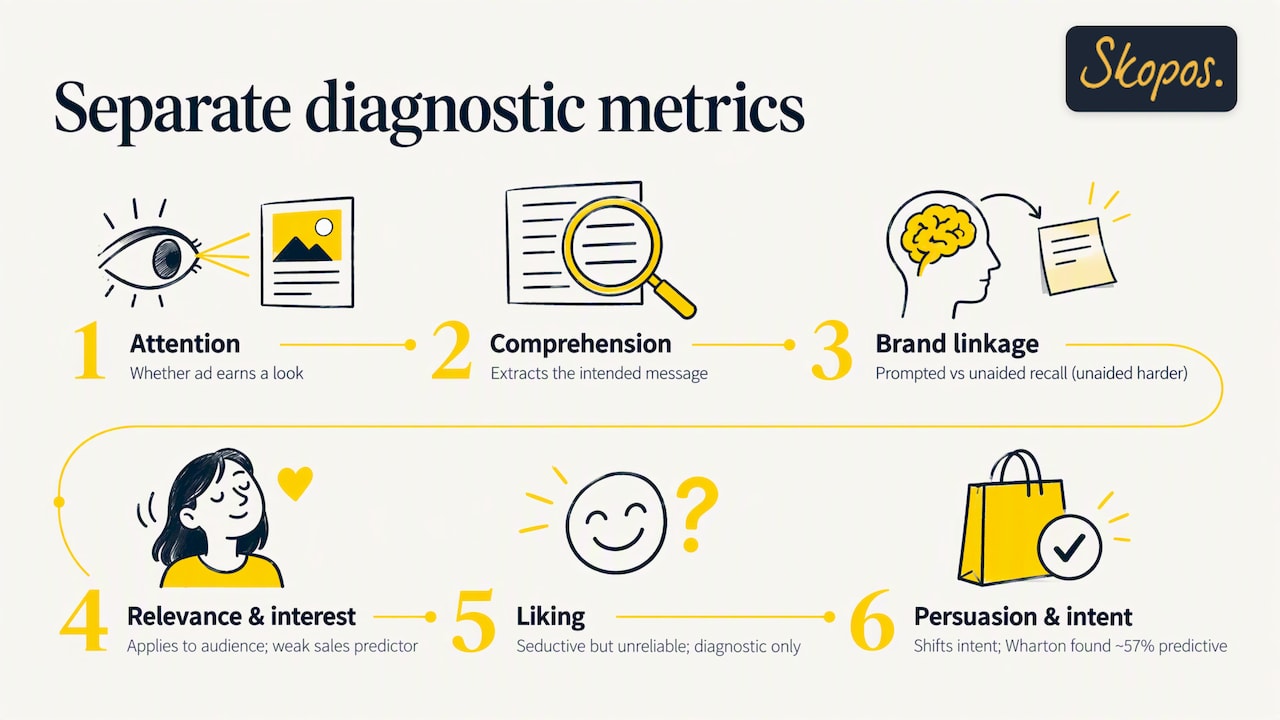
The copy testing metrics worth commissioning fall into six or seven constructs: attention, comprehension or main-point communication, brand linkage and memorability, relevance and interest, liking, and persuasion or purchase intent. The organising rule that matters more than any single number is this: choose the battery that matches the ad’s intended job, whether that’s stopping power, message transmission, brand building or driving action.
Purchase intent is directional, selecting the higher performing ad correctly about 57% of the time; structured persuasion scoring reached roughly 75% in matched comparisons.
Diagnose results in sequence: weak attention points to the opening, weak brand linkage to brand cues, and weak persuasion to the offer or benefit.
Forced exposure improves comprehension measurement but inflates attention; simulated or in context viewing gives a more realistic attention read at greater cost and fieldwork time.
Before fieldwork, define the business outcome, success threshold, sample, and exposure frequency, then distinguish a statistically real shift from one large enough to matter commercially.
Treat liking as diagnostic, not a decision rule, because liked ads can fail commercially; composite scores also hide constructs that may move independently
Core metric categories and what each tells you
Each construct answers a different commissioning question, and conflating them is the single most common mistake we see in creative testing briefs.
Attention measures whether the ad earns a look in the first place. It’s typically captured through eye-tracking, click-through on a thumbnail stimulus, or self-reported stopping power (“How likely would you be to stop and look at this?”). Attention predicts nothing about message quality on its own.
Comprehension and main-point communication test whether the audience extracted the intended message, usually through open-ended “what is this ad telling you?” prompts coded against the brief’s key message.
Brand linkage and memorability separate prompted recognition (“have you seen this before?”) from unaided recall (“what ads have you seen for this category recently?”). Unaided recall is the harder, more diagnostic test, because a memorable ad that nobody attributes to the right brand has a rework problem, not a creative problem.
Relevance and interest gauge whether the audience feels the message applies to them. These are useful early filters but weak standalone predictors of sales effect.
Liking is the most seductive and least reliable metric in the battery. An ad can be warmly liked and commercially inert, or mildly disliked and highly persuasive. Treat liking as a diagnostic input, never a decision criterion.
Persuasion and purchase intent come closest to a behavioural proxy, shifting stated likelihood to buy or consider pre-versus post-exposure. Even here, predictive validity research from Wharton found that copy-testing purchase-intent predictions selected the higher-recall ad correctly only around 57% of the time across large samples, useful above chance, far from a guarantee.
This is precisely why composite single scores are risky: they collapse constructs that move independently into one number, hiding exactly the diagnostic detail a commissioning team needs to decide what to fix, as discussed in frameworks like those outlined in LLM evaluation frameworks for marketing leaders | AuthorityLayer Insights.
Choose metrics to match the ad’s job (a decision framework)
Before specifying a questionnaire, define the decision the test needs to support. We find four recurring ad jobs, each pointing to a different compact battery.
Stopping power for a crowded channel: prioritise attention and brand linkage; supports a go/no-go on the creative concept before media spend commits.
Message communication for a new product or claim: prioritise comprehension and main-point recall; supports creative rework decisions when the intended message isn't landing.
Brand-building for long-term equity: prioritise brand linkage, relevance and liking as secondary diagnostics; supports media mix and frequency decisions rather than immediate creative change.
Activation for near-term response: prioritise persuasion and purchase intent alongside comprehension; supports launch timing and offer-strength decisions.
Each battery carries different trade-offs. Forced-exposure online surveys are cheaper and faster but less naturalistic; simulated or in-context exposure costs more and takes longer but produces findings closer to real media conditions. Sample type matters too: category buyers versus general population will shift persuasion scores meaningfully.
Before fieldwork begins, pre-specify four things: the criterion outcome the business will act on, the benchmark or threshold for success, the exposure assumptions (single or repeated viewing), and the sample definition.
Pro Tip:Write the decision rule before you see any data: “If brand linkage falls below our benchmark, we rework the opening five seconds” is far more useful after the fact than after the result.
How to measure these metrics in practice: design choices and common pitfalls
Question wording should map directly to the construct you’re testing, not to a generic “rate this ad” scale. Attention uses stopping-power stems; comprehension uses open-ended main-message capture, coded rather than scaled; brand linkage separates prompted and unaided recall explicitly; persuasion uses a pre/post purchase-intent shift on a standard intent scale.
Forced exposure (requiring the respondent to view the full ad) maximises comprehension measurement but inflates attention scores unrealistically.
Simulated or naturalistic exposure (embedding the ad in a feed or programme break) gives a more honest attention read but costs more in sample and fieldwork time.
Single-exposure tests understate real campaign effects, since modelling of exposure frequency shows that repetition moderates attitudinal and behavioural response; specify how many exposures the test simulates and whether that matches the planned media schedule.
Day-after recall remains a standard benchmark for broadcast-style awareness, while simulated-market uplift is more appropriate for activation-focused batteries.
Unaided recall is best reserved for crowded categories where brand confusion is the real risk.
One in roughly 1.75 predictions is wrong even in validated models, since large-sample predictive-validity research put copy-testing purchase-intent accuracy at about 57%, a meaningful improvement on chance but no substitute for judgement.
The recurring pitfalls we see: treating liking as a proxy for persuasion when the two routinely diverge; leaning on a single metric to carry a decision that needs a battery; and running samples too small to detect a meaningful shift in intent, which makes a “no difference” result impossible to interpret with confidence.
Interpreting results and turning metrics into decisions
Set thresholds before the data arrives, and separate statistical significance (is the shift real) from practical significance (is the shift big enough to matter commercially). A one-point intent shift that’s statistically significant on a huge sample may still be too small to justify a media change.
A useful diagnostic flow runs in sequence: attention first, then comprehension, then brand linkage, then persuasion. A failure early in that chain usually explains a failure later in it.
Low attention, fine comprehension: the opening needs stronger stopping power, not a new message.
Fine attention, weak linkage: add or strengthen brand cues, don't rewrite the concept.
Fine attention and linkage, weak persuasion: test a stronger motivational hook or offer, not the creative's visual treatment.
Signal pattern
Likely cause
Typical fix
Low attention, strong comprehension
Weak opening or format mismatch
Rework first five seconds, change format
Strong attention, weak brand linkage
Insufficient brand cues
Strengthen branding, logo placement, colour cues
Strong linkage, weak persuasion
Message lacks motivational strength
Test stronger offer or benefit framing
Strong all constructs, weak sales lift
Media or targeting mismatch
Review reach, frequency, channel mix
That last row matters: when every copy metric looks healthy but business results don’t follow, the fix usually sits in media and targeting decisions, not the creative itself.
Author perspective and Skopos practice
Having commissioned and analysed creative tests across financial services, consumer brands and B2B categories, the clearest lesson is that commissioning teams get better decisions by specifying the ad’s job before writing a single question. We’ve applied this metric-battery approach within our ad and creative testing work, pairing it with brand tracking and segmentation so test results connect to longer-term brand measures rather than sitting as one-off scores.
How Skopos helps commissioning teams with copy testing
Commissioning a copy test well means specifying the decision first, which is where a senior-led consultancy earns its place over a self-serve panel tool. Our Ad & Creative Testing work builds the metric battery around your specific go/no-go or rework decision, backed by our broader concept and product testing and customer segmentation capabilities when the question extends beyond a single ad.
A discovery call to define the ad's job and the decision the test needs to support.
A pilot test against a pre-specified decision rule, not a generic scorecard.
Governance and roll-out guidance so results feed your ongoing brand tracking programme.
Pro Tip:Bring your media plan to the discovery call: exposure frequency assumptions change which metrics matter most.
For organisations building a continuous testing capability rather than a one-off study, our Foundation, Growth and Strategic insight partner plans cover ongoing creative and brand research; current prices are on the pricing page.
FAQ
What are the most important copy testing metrics to track?
The core constructs are attention, comprehension, brand linkage, relevance, liking and persuasion or purchase intent. Which ones matter most depends entirely on the ad’s job: a launch ad needs comprehension and persuasion, while a brand ad in a crowded category needs attention and linkage.
Does liking predict whether an ad will be persuasive?
Not reliably. Liking and persuasion are related but distinct constructs, and an ad can score well on one while scoring poorly on the other, so liking should be read as a diagnostic input rather than a decision metric.
How accurate is purchase intent at predicting ad success?
Predictive-validity research found that purchase-intent predictions selected the higher-performing ad correctly around 57% of the time in large samples, better than chance but not a guaranteed forecast. Combining intent with structured, evidence-based persuasion scoring improved accuracy to roughly 75% in matched comparisons.
Should exposure frequency affect how I design a copy test?
Yes. Exposure-frequency modelling shows that repeated exposure changes attitudinal and behavioural response, so a single-exposure test can understate a campaign’s real effect if the media plan involves repetition.
What does Skopos offer for copy and creative testing?
Our Ad & Creative Testing service builds a metric battery around your specific commissioning decision, and our broader service list covers related capabilities such as brand tracking and concept testing for teams building a continuous measurement programme.