

June 15, 2026

10
min read
Measuring marketing ROI with research: 2026 guide
Learn how to measure marketing ROI with research using incrementality testing, marketing mix modelling and causal evidence that goes beyond platform attribution.

Learn how to measure marketing ROI with research using incrementality testing, marketing mix modelling and causal evidence that goes beyond platform attribution.

Measuring marketing ROI with research is defined as quantifying the true causal impact of marketing activity through methods like incrementality testing and marketing mix modelling (MMM), rather than relying on platform attribution alone. The standard industry term for this discipline is marketing effectiveness measurement. Where basic attribution tells you which touchpoints preceded a conversion, causal inference asks what would have happened without your marketing at all. Tools like incrementality testing, MMM, and continuous measurement workflows give marketing professionals and business leaders the evidence needed to allocate budgets with genuine confidence. This guide explains how each method works, how they fit together, and where teams typically go wrong.
Marketing ROI is calculated as (Sales Growth minus Marketing Cost) divided by Marketing Cost. That formula is straightforward. The hard part is knowing whether the sales growth you are measuring was genuinely caused by your marketing, or whether those customers would have converted anyway.
Attribution models, whether last-click, data-driven, or multi-touch, assign credit to touchpoints. They describe a sequence of events. They do not prove causation. A customer who saw your brand ad on YouTube and then searched for your product may have searched regardless. Attribution would credit both touchpoints. Incrementality testing would reveal whether the ad actually changed behaviour.

This distinction matters enormously for budget decisions. If you are paying for conversions that would have happened without your spend, you are not generating return. You are generating noise that looks like return. Research-driven measurement moves the conversation from “what happened?” to “what did our marketing actually cause?”
Incrementality is defined as the causal lift in conversions above the baseline that would have occurred without marketing. It is the most direct answer to the question every CFO eventually asks: “Would we have got those sales anyway?”
The standard method uses a test-and-holdout design with a holdout audience typically representing 10–20% of the total group. The holdout receives no marketing exposure. The test group receives the campaign as normal. After a defined period, you compare conversion rates between the two groups.
Here is a concrete example of how the lift calculation works:
Platforms including Meta and Google Ads support randomised holdout experiments natively. For offline channels or geographies where individual-level randomisation is not possible, geo lift tests compare matched regions instead.
Pro Tip: Target your first incrementality tests at the channels where platform-reported ROAS is highest. Those are precisely the channels most likely to be overclaiming, and the findings will generate the most immediate budget reallocation value.
The reason incrementality is more trustworthy than platform attribution is structural. Attribution models are built by the same platforms selling you the media. They have a commercial incentive to show favourable results. Incrementality testing is an independent experiment. The data is yours.
Marketing mix modelling is a regression-based statistical technique that links historical spend and exposure data across channels to business outcomes over time. Where incrementality testing produces precise causal estimates for specific campaigns, MMM provides a portfolio view across all channels simultaneously.
A well-specified MMM typically includes:
The model estimates a coefficient for each channel, representing its contribution to the outcome variable (usually revenue or sales). It also applies adstock transformations to account for the delayed and decaying effect of advertising exposure, and saturation curves to model diminishing returns at higher spend levels.
The critical limitation of MMM is that its coefficients are derived from observational data. Correlation can masquerade as causation. Without external validation, MMM coefficients can be off by 50% or more. A channel that happens to spend more during high-demand periods will appear more effective than it actually is.
Calibration solves this problem. By feeding incrementality test results or geo lift test results into the MMM as priors or constraints, you anchor the model’s channel coefficients to experimental evidence. The model retains its portfolio breadth while gaining causal reliability.
Pro Tip: MMM requires at least 52 weeks of data at weekly granularity to produce stable estimates. If your data history is shorter than this, start with incrementality testing and build your MMM dataset in parallel.
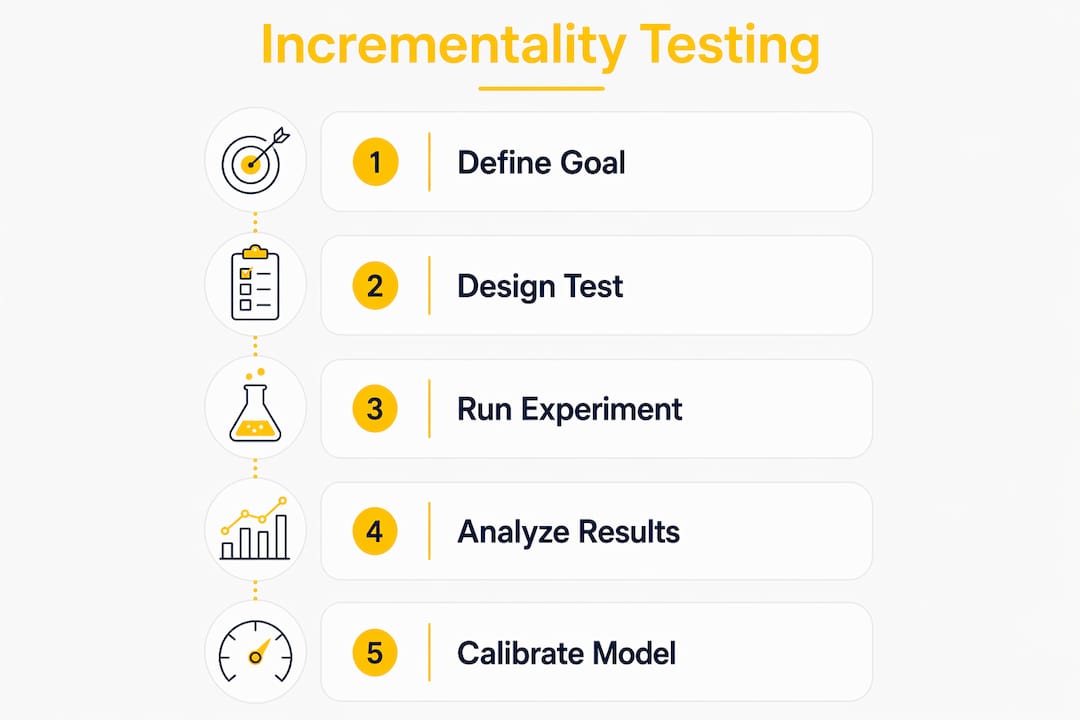
The most effective teams treat marketing measurement as a continuous flywheel, not a one-off project. The workflow moves through four distinct stages, each building on the last.
For board-level reporting, the most credible metric is incremental net profit ROI (iROI). The iROI formula is: (Incremental Net Profit minus Media Costs) divided by Campaign Budget. It accounts for both short-term and long-term impact horizons and speaks directly to the financial outcomes that finance teams and executives care about.
The power of this workflow is cumulative. Each round of testing improves your MMM calibration. Each MMM update improves your budget allocation. Better allocation generates cleaner data for the next round of tests. Over time, the quality of your decisions compounds.
Research-driven measurement is only as good as the experimental discipline behind it. Several mistakes consistently undermine results.
Pro Tip: Use incrementality results to calibrate your attribution model rather than abandoning attribution entirely. This turns correlation-based attribution into a more trustworthy decision input without requiring continuous live experiments.
The cost of holdout tests is real. Withholding marketing from a segment means accepting some short-term revenue risk. Focus your tests on the channels where disagreement between platform ROAS and expected incrementality is highest. That is where the learning value justifies the cost.
Getting started does not require a complete overhaul of your measurement infrastructure. A phased approach works well for most organisations.
Tools like Cometly and Presenc AI support causal inference workflows and MMM calibration for teams building this capability in-house. For organisations without dedicated data science resource, working with a specialist research partner is often the faster route to decision-grade evidence.
The organisational dimension matters as much as the technical one. Analytics, marketing, and finance teams need to agree on the measurement framework before results are produced. When finance teams understand how iROI is calculated and trust the experimental design behind it, budget conversations become evidence-led rather than political.
Continuous measurement loops improve decisions and marketing performance over time. The teams that commit to this discipline consistently outperform those that rely on attribution alone.
Research-driven marketing ROI measurement requires incrementality testing, MMM calibration, and a continuous measurement workflow to produce causal evidence that justifies budget decisions.
I have worked with marketing teams across a wide range of sectors, and the pattern is remarkably consistent. Most teams know their platform ROAS figures in detail. Very few know their incremental ROAS. The gap between those two numbers is often where significant budget is being wasted.
The misconception I encounter most often is that attribution and incrementality are measuring the same thing in different ways. They are not. Attribution describes a sequence. Incrementality tests a counterfactual. Once teams genuinely understand that distinction, their entire approach to measurement changes.
The organisational hurdles are real. Data sits in silos. Finance teams distrust marketing metrics. Stakeholders want simple answers from complex systems. I have seen well-designed measurement programmes stall because the results challenged a channel that a senior leader had championed for years. The technical work is often easier than the internal communication work.
My practical advice is to start small and build credibility. Run one clean incrementality test on your highest-spend channel. Present the results in revenue terms to your finance director before you present them to your marketing team. When finance trusts the methodology, the budget conversations that follow are far more productive.
The teams that get this right do not treat measurement as a reporting function. They treat it as a decision-making function. That shift in framing changes everything about how research is designed, interpreted, and used.
Skopos designs and runs incrementality tests, MMM calibration programmes, and continuous measurement frameworks for marketing teams that need decision-grade evidence, not just data. Whether you are running controlled test-and-holdout campaigns across digital channels or building a portfolio measurement model across UK and international markets, Skopos brings the research rigour and commercial focus to make the results genuinely useful.
If your current measurement approach relies primarily on platform attribution, there is a strong chance your budget allocation is not reflecting true causal return. Skopos’s custom research services are built to close that gap. Explore how Skopos can help your team move from attribution to incrementality, and from reporting to real decisions. You can also browse the research glossary for clear definitions of the key measurement terms covered in this guide.
Attribution assigns credit to touchpoints in a customer journey. Incrementality measures whether those touchpoints actually caused the conversion, using controlled experiments to compare outcomes with and without marketing exposure.
The test window should cover the full sales cycle from first exposure to conversion. For e-commerce this may be one to two weeks; for B2B or considered purchases, several weeks or months may be required for reliable results.
MMM typically requires at least 52 weeks of weekly data covering spend, impressions, and revenue across all channels, alongside contextual variables such as seasonality and pricing to produce stable, reliable coefficient estimates.
Apply lift test results to calculate incremental ROAS by channel, then model saturation curves to identify marginal ROAS. Shift budget toward channels with the highest marginal return before diminishing returns reduce efficiency.
Yes. Start with a single holdout test on your largest channel using native tools in Meta or Google Ads. Even one well-designed test produces more reliable budget guidance than relying on platform attribution dashboards alone.