

June 19, 2026

8
min read
The role of data in marketing decisions: 2026 guide
A practical guide to using marketing data, AI and analytics to make better decisions, reduce wasted spend and turn insight into action.

A practical guide to using marketing data, AI and analytics to make better decisions, reduce wasted spend and turn insight into action.

Data-driven marketing is defined as the practice of basing every strategic and tactical decision on unified, accurate, and contextualised data rather than intuition. The role of data in marketing decisions has never been more consequential. Poor data infrastructure costs businesses approximately $66 billion annually in wasted marketing spend. That figure alone makes the case for treating data not as a reporting tool, but as the foundation of every campaign, budget call, and audience decision. Platforms like Google Analytics 4 and Customer.io have made real-time behavioural data accessible at scale, yet most marketing teams still struggle to translate numbers into decisions.
The role of data in marketing decisions is to replace assumption with evidence at every stage of the customer journey. When marketers connect behavioural signals to campaign logic, they stop guessing which message will resonate and start knowing. Behavioural triggers account for 29% of personalisation ROI, while attribute-based segmentation drives 31%. Together, they represent the two highest-return applications of data in modern marketing.

Artificial intelligence has accelerated this shift considerably. AI tools now handle campaign optimisation, performance analysis, and personalisation at scale, but only when fed clean, connected data. The practical implication is clear: your data quality determines your AI output quality. A poorly structured data set produces poorly targeted campaigns, regardless of how sophisticated the platform is.
Real-time data usage matters as much as data quality. Continuous optimisation loops, where campaigns are adjusted based on live performance signals rather than monthly reports, consistently outperform static approaches. Marketers using this model can reallocate budget mid-flight, suppress underperforming creative, and scale what is working before the window closes.
Pro Tip: Set a single primary metric for each campaign before it launches. Teams that define success upfront make faster, cleaner decisions when the data comes in.
The most common mistake in data-driven marketing is confusing access to data with actually using it well. Most marketing teams confuse having data with being data-driven. Real impact requires translating raw data into clear marketing actions tied to specific business questions. This gap, often called the translation layer, is where most programmes stall.
Vanity metrics are a significant part of the problem. Page views, social media followers, and email open rates feel meaningful because they move. They rarely connect to revenue. When a team celebrates a 40% open rate without asking whether those opens led to purchases, they are optimising for the wrong signal entirely.
“Data without a clear business question is noise. Marketing teams must focus on metrics linked directly to decisions.” — LayerFive, 2026
Inconsistent metric definitions compound the issue further. Inconsistent metric definitions across systems undermine AI-driven marketing decisions and erode trust in reporting. If your CRM defines a “conversion” differently from your analytics platform, every report becomes unreliable. The fix is documentation: a shared, written definition of every metric used in decision-making, agreed across teams and systems.
The cultural dimension is equally important. The shift from gut feeling to evidence-based inquiry is more consequential than any technology adoption. Tools do not make a team data-driven. Habits, processes, and the willingness to be wrong when the data says so are what actually change outcomes.
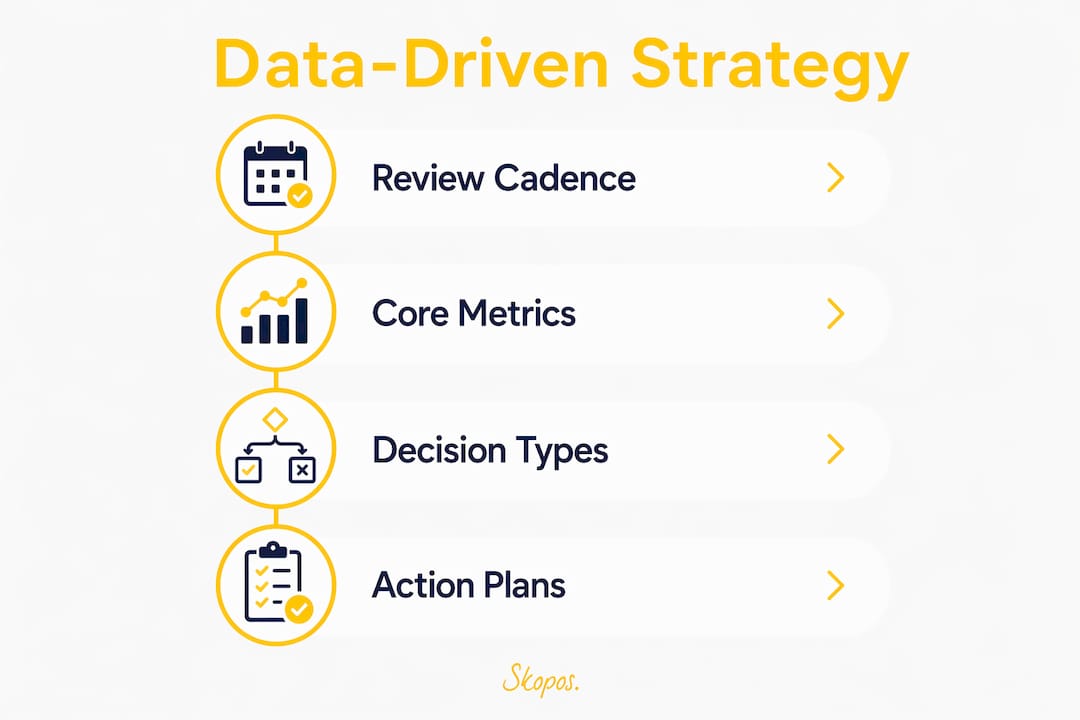
A structured framework turns data from a reporting function into a decision-making engine. The following five-step approach, informed by Analytify’s guidance on data-driven marketing strategy, gives marketing teams a repeatable process for connecting analytics to outcomes.
The table below shows how review frequency maps to decision type:
Pro Tip: When reviewing monthly performance, ask one question before acting on any finding: “What decision does this data require?” If you cannot answer it, the metric is not yet connected to your strategy.
For teams building this capability from scratch, the from data to decisions resource from Skopos offers a practical guide to making insights land across the business.
Advanced analytics and artificial intelligence are redefining what is possible in marketing, but they introduce new requirements that many teams are not yet prepared for. AI marketing agents perform best with complete, connected, and contextualised data sets rather than simplified dashboards designed for human review. This is a fundamental shift. AI does not interpret data the way a human analyst does. It requires explicit context, unified definitions, and complete attribution chains to function reliably.
The concept of the “agentic era” describes a near-future state where AI agents autonomously execute marketing tasks, from bid management to content personalisation, based on data inputs alone. For this to work, marketers must rethink data as a holistic asset rather than a collection of reports. Experienced marketers understand the nuances of data definitions across systems that AI lacks, which means human oversight and explicit documentation remain non-negotiable.
Genetic algorithms represent one of the more compelling applications of advanced analytics in e-commerce marketing. Research published in Nature found that genetic algorithm optimisation produces a 21% average increase in customer satisfaction. That result comes from the algorithm’s ability to test thousands of variable combinations simultaneously, something no human team can replicate manually.
The practical takeaway for marketing teams is this: the more you invest in data quality, documentation, and unified infrastructure now, the better positioned you will be to extract value from AI tools as they mature.
Analytics in marketing decisions delivers the greatest returns when data quality, clear decision rules, and a structured review process work together as a system.
I have worked with marketing teams across sectors, and the pattern is consistent. The problem is rarely a lack of data. Teams have Google Analytics 4, CRM exports, paid media dashboards, and customer surveys. The problem is that none of it connects to a decision.
What I have found is that the translation layer challenge is fundamentally a leadership problem, not a technical one. When senior marketers do not define what a good decision looks like before the data arrives, analysts fill that vacuum with whatever looks interesting. The result is a 40-slide deck that generates discussion but no action.
The teams that get this right do something deceptively simple. They write down, in advance, what they will do if a metric goes up and what they will do if it goes down. That single discipline, applied consistently, moves the conversation from “what happened?” to “what do we do next?” It also makes AI tools dramatically more useful, because the decision logic is explicit rather than assumed.
My honest observation is that the cultural shift matters more than the technology. I have seen well-resourced teams with enterprise analytics platforms make worse decisions than smaller teams using spreadsheets and clear thinking. The difference is always the same: one team asks business questions first and uses data to answer them. The other collects data and hopes a question emerges.
If you are building or rebuilding your approach, start with the decision frameworks that connect metrics to actions. The tools will follow.
Marketing professionals who want to move from data collection to genuine decision-making often need more than a better dashboard. They need research that is designed around commercial questions from the outset.
Skopos is a full-service market research and insight consultancy working with brands across the UK, Europe, and international markets. Skopos combines customer segmentation research, concept testing, brand tracking, and advertising research to give marketing teams the evidence they need to act with confidence. Whether your priority is understanding a new audience, testing a campaign before it launches, or tracking brand health over time, Skopos builds research programmes around the decisions you need to make. Explore the full range of market research services or browse the marketing research glossary to sharpen your team’s analytical vocabulary.
Data provides a verifiable, unified source of truth that guides strategy, budget allocation, and audience targeting. It replaces intuition with evidence, reducing wasted spend and improving campaign precision.
Behavioural triggers account for 29% of personalisation ROI, while attribute-based segmentation drives 31%, according to Customer.io’s 2026 marketing report. Together they represent the highest-return applications of data in personalised marketing.
Having data means collecting metrics. Being data-driven means connecting those metrics to specific decisions and actions. Most teams have the former but lack the translation process that produces the latter.
Weekly reviews should cover traffic and engagement metrics for tactical adjustments. Monthly reviews should assess conversions, channel performance, and budget efficiency to inform strategic decisions.
Effective marketing tests require at least 95% statistical confidence, a minimum 30-day run time, and sample sizes of at least 10,000 per variant to avoid false positives and unreliable conclusions.