

October 13, 2026

8
min read
Go to Market Research for Launch Teams: Test Price Before Spending
Discover how go-to-market research helps validate demand, identify customers, test pricing and build a successful product launch strategy.

Discover how go-to-market research helps validate demand, identify customers, test pricing and build a successful product launch strategy.

Go-to-market research is the structured evidence gathering that tells a launch team whether demand exists, who to sell to first, what to charge and which channels will work before money is committed. Done well, it delivers validated demand, prioritised segments, pricing guidance and the metrics needed to judge launch performance. It combines qualitative work, such as interviews, with quantitative methods, including surveys and pricing tests, so findings are both meaningful and measurable.
Go-to-market research is narrower than a general market assessment. A market assessment asks whether an opportunity exists at all; go-to-market research assumes the opportunity is real and answers the operational questions that determine how a specific launch should happen. It typically sits inside, or follows, that broader assessment and feeds the launch plan directly rather than a strategic review.
A well-scoped GTM research programme answers questions such as:
The outputs that answer these questions are consistent across sectors: a sized opportunity using TAM, SAM and SOM frameworks, an Ideal Customer Profile, pricing test results and a shortlist of recommended channels. Together these give a launch team something to act on rather than a descriptive report to file away.
Launches fail less often because the product is wrong and more often because the targeting, pricing or timing is wrong. Research reduces that risk by replacing assumptions with evidence before budget is spent on campaigns, sales hires or inventory.
Research also gives product, marketing and sales a shared reference point. When all three teams work from the same segment definitions and pricing evidence, launch messaging stays consistent and sales conversations match what marketing promised.
Timing matters as much as method:
For B2B launches specifically, enterprise sales cycles often span 6 to 12 months, so Ideal Customer Profile research needs to inform resourcing and process planning well before the first pitch, not after.
Choosing the right method depends on what decision the research needs to support. A mixed-methods approach, combining desk research, interviews, concept testing and short surveys, tends to balance speed against confidence better than relying on a single technique.
Method choice should also reflect audience size and type:
Sampling and data quality deserve particular attention in niche B2B research. The Market Research Society (MRS) guidance on survey data collection requires researchers to document sampling characteristics and ensure data collection is fit for purpose, which matters most when the buying audience is small and every respondent’s seniority and relevance need to be checked rather than assumed.
Research only earns its budget when it changes a decision. The practical route from findings to plan runs through four classic levers: product, price, place and promotion.
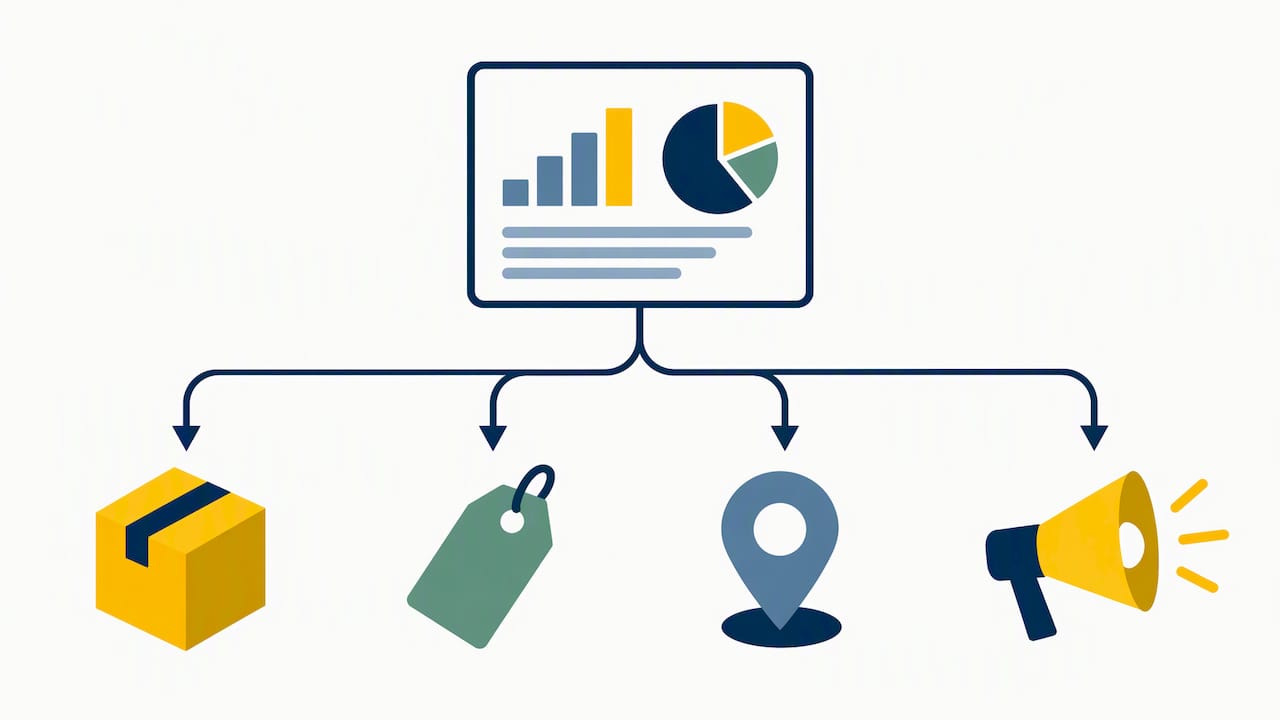
Start by mapping the Ideal Customer Profile and TAM/SAM/SOM figures onto a short list of prioritised segments and the channels most likely to reach them. Not every segment that looks attractive on paper is reachable at a reasonable cost, so channel feasibility should narrow the list further.
Pricing research then sets the initial price point and the value messaging that justifies it:
From there, design a pilot with measurable launch metrics agreed in advance, conversion rate, cost per acquisition, or early retention, depending on the model. Build in a short post-launch research loop so the first real customer feedback can adjust messaging or targeting quickly rather than waiting for a full quarterly review.
Pro Tip: Agree your top three launch metrics with sales, marketing and product before the pilot starts, not after the first results land.
A good brief does most of the work of a good research project. It should state the decision the research needs to inform, the hypotheses being tested, the target segments and the criteria that will count as success.
Pro Tip: Ask for decision-maker coverage and quota logic in any B2B sample report, not just a headline response count, so stakeholders can judge how representative the findings really are.
A recent engagement pattern we have seen play out repeatedly starts with an Ideal Customer Profile exercise, moves into a pricing test, and ends with a small pilot before full launch investment, each stage narrowing the plan rather than adding more analysis for its own sake.
Senior-led judgement applied to disciplined research methods, including carefully used
and AI tools, turns raw findings into recommendations a leadership team can act on without further interpretation.
We built our market research glossary and our guidance on running multi-market research without losing comparability for exactly this kind of situation, where teams need shared definitions and consistent methods across more than one market.
Teams often size the whole addressable market instead of a realistic serviceable and obtainable share, which inflates expectations and skews resourcing. In B2B, sampling errors are common when surveys chase volume instead of reaching the right decision-makers in depth. The third misstep is treating research as a one-off report rather than a continuing feedback loop that should keep informing the plan after launch.
We run go-to-market research as a full-service capability, covering market entry and expansion research, customer segmentation, concept and product testing, and pricing and value perception studies, so a launch team gets one consistent evidence base rather than fragments from separate suppliers.
Typical engagements may provide direct access to consultants running the work, with findings delivered as an executive summary, a dashboard and the underlying data the analytics team can reuse.
Current prices for the different engagement levels are available on the pricing page of the client’s website.
Full details on each insight partner model are on our site, or browse the complete service list to see which combination fits your launch.
GTM stands for go-to-market, the plan for how a product or service reaches customers, covering target segments, pricing, channels and messaging. Go-to-market research is the evidence base, qualitative and quantitative, that informs those decisions before launch.
AI tools like ChatGPT can help summarise desk research, draft interview guides or spot themes in open-text survey data, which speeds up parts of the process. They cannot replace primary data collection, properly sampled surveys or the judgement needed to interpret findings against MRS professional standards.
The most common errors are sizing the total addressable market instead of a realistic obtainable share, sampling the wrong decision-makers in B2B research, and treating a research report as a one-off exercise rather than an ongoing loop. Each of these narrows the usefulness of otherwise solid data.
There is no single definitive list, since tool choice depends on method: survey platforms for quantitative work, interview and transcription tools for qualitative research, and dashboard software for tracking results. What matters more than the tool is whether the sampling and analysis behind it meet recognised research standards.
For teams wanting formal guidance beyond this article, the MRS Code of Conduct sets the professional standard for sampling transparency and data handling that any commissioned research should meet. The GOV.UK Ideal Customer Profile template offers a practical starting structure for segmenting B2B buyers by procurement readiness. Our own glossary of research terms is a useful reference for TAM, SAM, SOM, ICP and pricing technique definitions used throughout this guide.