

July 10, 2026

7
min read
Customer segmentation analysis process: a practical guide
Learn how customer segmentation analysis combines qualitative research, customer data, cluster analysis and AI to create actionable segments.

Learn how customer segmentation analysis combines qualitative research, customer data, cluster analysis and AI to create actionable segments.

Customer segmentation analysis is the systematic process of dividing a customer base into distinct, meaningful groups to improve marketing precision and drive revenue growth. The discipline sits at the heart of modern marketing strategy. Companies with effective segmentation and personalisation derive 40% more revenue than slower-growing peers. That figure reflects a simple truth: when you speak to the right people with the right message, results follow. The customer segmentation analysis process moves marketing from broad assumptions to evidence-based decisions, and this guide walks through every stage, from data preparation to ongoing model management.
The quality of your segmentation depends entirely on the quality of your data. Four core data types feed a reliable model: CRM records, web analytics, transaction histories, and behavioural data such as email engagement or in-app activity. Each source captures a different dimension of customer behaviour, and combining them produces a far richer picture than any single source alone.
Before analysis begins, audit your data for completeness and consistency. Gaps in CRM records or mismatched identifiers across platforms will distort cluster outputs and produce segments that do not reflect reality. Refreshing data quarterly keeps profiles current and prevents the model from drifting out of step with actual customer behaviour.

The table below outlines the typical inputs and tool categories used across a segmentation project.
Statistical techniques sit alongside these tools. Cluster analysis, and k-means clustering in particular, groups customers by mathematical similarity across chosen dimensions. Machine learning methods extend this by identifying non-linear patterns that standard statistical models miss. The choice of technique should match your data volume and the interpretability your marketing team needs.
Pro Tip: Start with two or three data dimensions rather than every available variable. Adding more dimensions too early produces clusters that are statistically interesting but commercially unusable.
A well-run segmentation project follows a clear sequence. Skipping phases, particularly the qualitative stage, is the most common reason projects produce segments that sit unused in a slide deck.
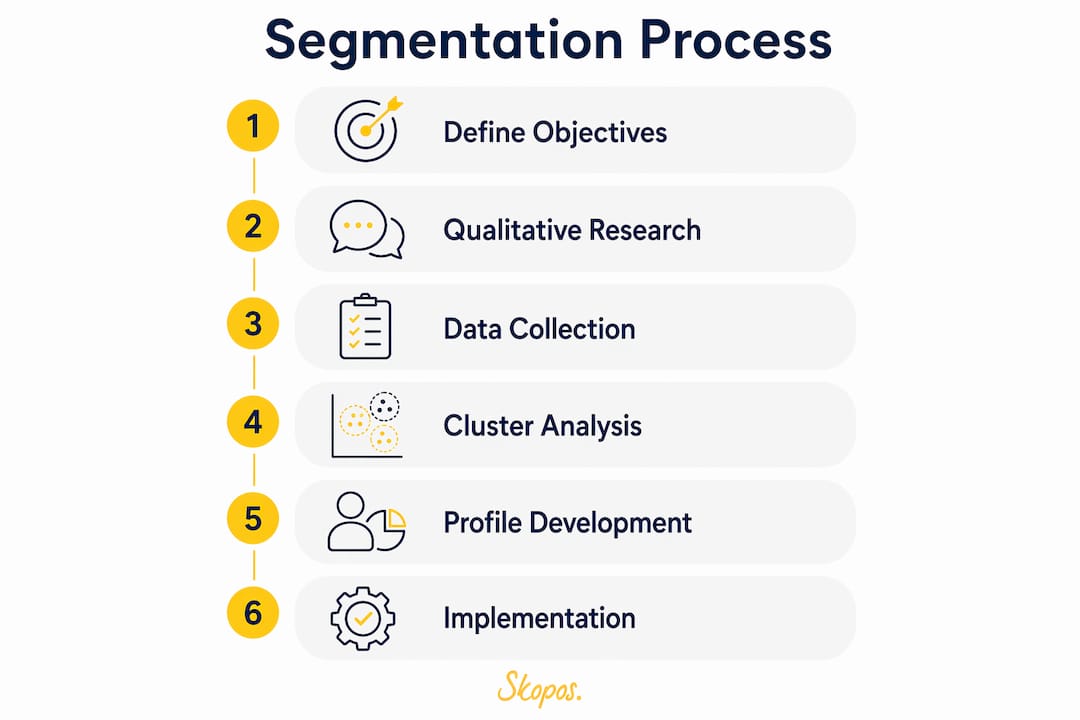
Traditional segmentation produces a static model. It reflects customer behaviour at the point of data collection and grows stale as markets shift. AI-driven segmentation enables dynamic, continuously updating segments based on real-time behavioural signals and improves forecasting of customer actions. That shift from a quarterly snapshot to a live model changes what marketing teams can do.
The practical benefits of AI-powered approaches include:
AI segmentation is shifting marketing from reactive to predictive strategies, improving customer engagement efficiency across the full lifecycle. Skopos applies AI methods through its Visioncue emotional tracking capability, combining machine-driven pattern recognition with human interpretation to keep outputs commercially grounded.
Pro Tip: AI models that produce segments no marketer can explain will not get used. Prioritise interpretability alongside predictive accuracy. A segment your team understands and trusts will always outperform a black-box output that sits unused.
The most damaging mistake in segmentation is confusing grouping with decision-making. Segmentation is foundational for personalisation, but the grouping exercise alone does not produce results. Targeting, the decision about which segments to prioritise and how to treat them, is a separate and equally important step. Projects that skip this distinction produce segments that describe customers accurately but drive no marketing action.
A second common failure is model complexity. Segmentation models often fail when too many dimensions are combined. Two to three core dimensions produce segments that are understandable, actionable, and usable across multiple teams. Adding a fourth or fifth dimension typically increases statistical variance without improving commercial utility.
Maintaining segment relevance over time requires a structured review cycle. Segmentation models should be evaluated and pruned quarterly, killing ineffective segments and splitting those with conflicting behaviours. A segment that drove strong results in one quarter may merge or fracture as the market shifts.
Best practices for maintaining segment quality include:
Pro Tip: Treat your segmentation model as a living system, not a completed project. Markets move, customer attitudes shift, and a model built two years ago may be actively misleading your marketing decisions today.
Effective customer segmentation analysis combines qualitative depth, quantitative rigour, and continuous model management to produce segments that drive real marketing results.
The segmentation projects I have seen succeed share one characteristic: the team treated the model as something to maintain, not something to deliver. The ones that failed almost always ended at the slide deck. The segments were well-named, the profiles were credible, and then nothing happened. No owner. No treatment plan. No review cycle.
The balance between data rigour and business usability is where most of the real work sits. A statistically elegant model that your media planning team cannot interpret will not change a single campaign brief. I have found that the most useful segmentation outputs are often the simplest ones: three or four segments with clear motivational labels, a one-page profile for each, and a named person responsible for each treatment.
Cross-functional buy-in matters more than most analysts expect. When the product team, the customer service team, and the marketing team all recognise their customers in the segments, adoption follows naturally. Getting those teams into the qualitative research phase, even as observers, makes a significant difference to how the final model lands. Skopos builds this kind of cross-functional research design into every segmentation engagement, because insight that is not used is not insight at all.
Skopos is a full-service market research consultancy with deep expertise in customer segmentation research across consumer, B2B, financial services, media, and technology sectors. The team combines qualitative depth interviews, quantitative survey design, and cluster analysis to deliver segments that are statistically sound and commercially usable.
Every Skopos segmentation engagement covers the full seven-stage process described in this guide, from objective definition through to activation support and quarterly review. For teams that need broader research context, Skopos also offers market research services spanning brand tracking, customer experience, and concept testing. If you are ready to build a segmentation model that your whole organisation will actually use, speak to the Skopos team.
Customer segmentation analysis is the process of dividing a customer base into distinct groups using data on attitudes, behaviours, demographics, and purchase history. The goal is to enable more precise targeting and personalised marketing across each group.
Most effective models produce three to six segments. Fewer than three often masks meaningful differences, while more than six creates complexity that reduces usability across marketing and product teams.
The most common cause of failure is the absence of assigned treatments and segment owners. Without explicit ownership and a distinct action plan for each segment, the model is never activated and delivers no commercial value.
Segmentation models should be reviewed quarterly, with underperforming segments pruned or split. A full model refresh, including new qualitative research, is advisable every 12–18 months.
Segmentation is the process of grouping customers by shared characteristics. Targeting is the subsequent decision about which segments to prioritise and what marketing treatment each will receive. Both steps are required for segmentation to drive results.