

June 17, 2026

10
min read
What is market gap analysis? a strategic guide
Market gap analysis helps businesses identify unmet customer needs, underserved segments and white space opportunities before investing in growth.

Market gap analysis helps businesses identify unmet customer needs, underserved segments and white space opportunities before investing in growth.

Market gap analysis is defined as the process of identifying unmet customer needs and underserved market segments by comparing what customers want with what current market offerings actually deliver. Often called “white space analysis” in strategic planning circles, it is the external counterpart to internal performance gap analysis, which focuses on operational metrics rather than market demand. Where internal gap analysis asks “are we hitting our targets?”, market gap analysis asks “what does the market need that nobody is providing?” For business analysts and strategic planners, the distinction matters enormously. Acting on the wrong type of gap leads to misdirected investment and missed opportunity.
Market gap analysis identifies unmet customer needs and underserved segments by comparing current offerings with actual consumer demand. The result is a map of “white space” where commercial opportunity exists but no adequate solution yet operates.
The importance of market gap analysis lies in what it replaces: guesswork. Without a structured approach, product teams and strategists rely on internal assumptions, competitor imitation, or anecdotal customer feedback. None of these reliably surface genuine demand. Market gap analysis replaces assumption with evidence, and evidence with prioritised opportunity.
Market gap analysis focuses on external market needs rather than internal performance benchmarks, which is a distinction that avoids misdirected action plans. A business that confuses the two risks investing in operational improvements when the real opportunity is a product category nobody has built yet.
The analysis also differs from competitor analysis in a subtle but critical way. Competitor intelligence matters, but the goal of market gap analysis is to find unmet needs starting from demand signals rather than competitor feature lists. You start with the customer, not the competition.

Market gaps fall into four main categories: product, service, price, and experience. Each type points to a different strategic lever and demands a different response.
Pro Tip: When you first identify a gap, label it by type before you do anything else. This single step will stop your team from defaulting to product development when the real issue is pricing or service delivery.
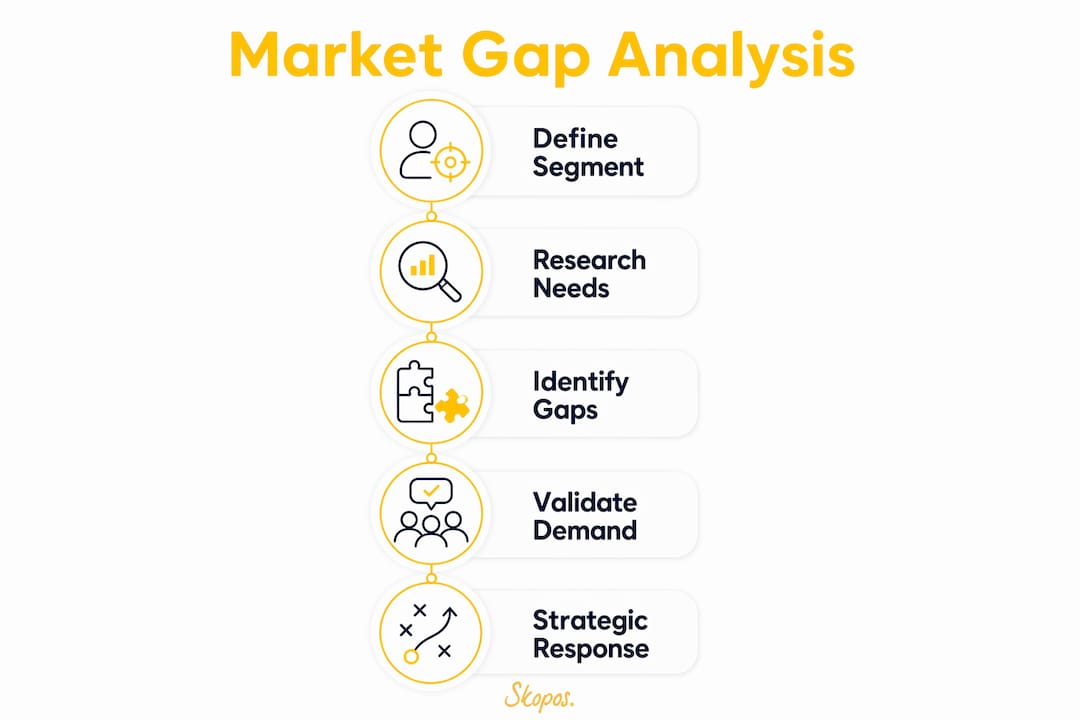
A structured market gap analysis follows five core steps: define your target market, research customer needs, assess current solutions, identify gaps, and validate opportunities before committing resources. Each step builds on the last, and skipping any one of them increases the risk of acting on a false signal.
Pro Tip: Run a lightweight validation exercise before any significant investment. A short-form survey with purchase intent questions, or a landing page test measuring sign-up rates, can confirm demand signals in days rather than months.
The most damaging error in market gap analysis is treating customer dissatisfaction as proof of market demand. The two are not the same. A customer who complains about a product may have no intention of switching, paying more, or adopting an alternative. Demand signals such as purchase intent and willingness to pay must be confirmed to avoid false positives. Look for evidence that customers are already spending money on workarounds, or that switching intent is high and rising.
A second common error is conflating internal performance gaps with market gaps. If your customer satisfaction scores are low because your delivery times are slow, that is an operational problem, not a market gap. Fixing it may retain customers, but it will not open new market territory. The distinction between internal and external gaps must be maintained throughout the analysis.
Several other pitfalls are worth noting:
Market gap findings translate directly into opportunity levers across product features, service model, pricing, and customer experience. The translation step is where analysis becomes strategy, and it is the step most organisations rush or skip entirely.
In product development, a confirmed product gap informs the roadmap directly. Rather than building features based on internal assumptions or competitor parity, teams can prioritise the capabilities that address the specific unmet need identified in the analysis. This is how new product development becomes demand-led rather than supply-led.
Market gap analysis precedes and informs competitive analysis: first find unmet needs, then assess how competitors respond to sharpen your positioning. This sequence matters. Analysts who start with competitor benchmarking often end up optimising for competitive parity rather than genuine differentiation.
The table below shows how gap types map to strategic responses across different planning contexts.
Early-stage businesses gain advantage through market gap analysis by discovering underserved niches and establishing first-mover positioning before larger competitors respond. For established organisations, the same process supports market entry decisions, portfolio rationalisation, and growth planning across new geographies. Skopos regularly applies this framework in market entry research engagements, combining qualitative depth with quantitative scale to give clients a reliable picture of where genuine opportunity sits.
Market gap analysis is the most reliable method for identifying commercially viable opportunities because it grounds strategic decisions in evidence of real, unmet customer demand rather than internal assumptions or competitor imitation.
After working on market research and strategic insight projects across multiple sectors, the pattern I see most often is this: organisations conduct a gap analysis and then act on the most visible finding rather than the most validated one. The loudest customer complaint becomes the product brief. The biggest competitor weakness becomes the positioning statement. Neither of these is market gap analysis. They are reactive decisions dressed up in analytical language.
The analyses that actually change strategy share one characteristic. They are built on a precise unit of analysis: a specific customer segment, doing a specific job, in a specific context. Without that precision, the gap you identify is too broad to act on and too vague to validate. I have seen teams spend months on research that produced findings like “customers want a simpler experience.” That is not a gap. That is a sentiment.
The other thing I would push back on is the assumption that gap analysis is a one-time exercise. Markets shift. Customer expectations move. A gap that was commercially unviable two years ago may now be the most attractive opportunity in your category. The organisations that treat gap analysis as a periodic discipline rather than a project tend to make better strategic decisions over time. They also tend to be faster, because they are not starting from scratch each time.
Skopos brings together qualitative research, quantitative surveys, customer segmentation, and competitive intelligence to give strategic planners a complete picture of where market gaps exist and which are worth pursuing.
Whether you are assessing a new market, rethinking your product portfolio, or preparing for expansion, Skopos builds the evidence base that turns gap identification into confident strategic decisions. Our market research services cover the full process from segment definition through to opportunity validation. For analysts building their knowledge base, our research glossary covers over 200 key terms used in gap analysis and broader insight work. Speak to Skopos to find out how structured market research can sharpen your next strategic planning cycle.
Market gap analysis is the process of identifying unmet customer needs and underserved market segments by comparing what customers want with what current market offerings provide. The result is a map of commercial white space where opportunity exists.
Market gap analysis starts from customer demand signals to find unmet needs, whereas competitor analysis benchmarks your performance against rivals. The two complement each other, but gap analysis should come first to avoid optimising for parity rather than differentiation.
The five core steps are: define your target segment, research customer needs using qualitative and quantitative methods, assess current market solutions, identify and prioritise gaps, then validate opportunities by confirming willingness to pay before investing.
Market gaps are specific situations where a defined customer group cannot find an adequate solution to a real problem at a price they are willing to pay. They fall into four types: product, service, price, and experience gaps.
Validation requires evidence of genuine demand, not just dissatisfaction. Look for purchase intent, spending on workarounds, and switching intent. Short-form surveys or prototype tests can confirm demand signals quickly before significant resources are committed.