

June 15, 2026

5
min read
What is customer loyalty research? a practical guide
Customer loyalty research helps brands understand why customers stay, recommend or leave, revealing the drivers of repeat purchase, retention and long-term value.

Customer loyalty research helps brands understand why customers stay, recommend or leave, revealing the drivers of repeat purchase, retention and long-term value.

Customer loyalty research is defined as the systematic study of the emotional and behavioural drivers behind repeat purchase, advocacy, and long-term commitment to a brand. Unlike customer satisfaction measurement, which captures how a customer feels at a single touchpoint, loyalty research explains why customers keep coming back and what would cause them to leave. It draws on tools including Net Promoter Score (NPS), Customer Effort Score (CES), and structured qualitative interviews to build a complete picture of retention risk and advocacy potential. For marketing professionals and business leaders, this discipline is the foundation of any credible customer retention strategy.
Customer loyalty research focuses on the drivers behind repeat purchase and advocacy, not simply whether customers are satisfied today. Satisfaction tells you a customer liked their last experience. Loyalty research tells you whether they will return in six months, recommend your brand to a colleague, and resist a competitor’s offer. Those are fundamentally different questions with fundamentally different commercial implications.
The importance of customer loyalty to business performance is well established. Loyal customers generate more predictable revenue, cost less to retain than new customers cost to acquire, and often act as unpaid advocates. Customer loyalty analysis therefore serves two strategic purposes: identifying what is working well enough to protect, and surfacing friction or unmet needs before they become churn.

The discipline also sits at the intersection of behavioural and emotional insight. Behavioural data tells you what customers do. Emotional and attitudinal research tells you why. Combining both is what separates loyalty research from simple transactional reporting, and it is what makes the findings genuinely useful for brand, marketing, and product decisions.
Loyalty measurement relies on a combination of quantitative surveys and qualitative methods, each capturing a different dimension of the customer relationship.
Quantitative methods provide the scores and trends that allow you to track loyalty over time and compare across segments:
Loyalty measurement combines these three metrics to capture different aspects of the customer relationship. Relying on NPS alone, for example, tells you whether customers would recommend you but not why they would or would not. Pairing NPS with CES by journey stage reveals both the symptom and the likely cause.
Qualitative methods add the depth that numbers cannot provide:
Surveys provide NPS, CES, and CSAT scores, while interviews reveal emotional drivers often missed by numeric scores. The two approaches are most powerful when designed to work together, with qualitative findings informing survey question design and quantitative results directing where qualitative exploration is most needed.
Pro Tip: Design your qualitative and quantitative workstreams in parallel, not sequentially. Running interviews before finalising your survey means you capture the language and motivations customers actually use, rather than the language your internal team assumes they use.
Customer retention and customer loyalty are related but distinct concepts. Confusing them leads to research that measures the wrong thing and strategies that address the wrong problem.
Pro Tip: If your customer health reporting only tracks retention rates and NPS, you are missing the middle layer. Add a measure of perceived value and ease of doing business to your tracking programme. These two variables are often the earliest indicators of loyalty erosion.
Demonstrating the financial return of a loyalty programme is one of the most persistent challenges in customer research. 41% of corporate loyalty programme leaders find quantifying programme ROI challenging. The difficulty is not a lack of data. It is a lack of the right measurement design.
Most loyalty programmes generate large volumes of transactional data but relatively little controlled evidence of programme impact. Knowing that enrolled members spend more than non-members does not prove the programme caused that difference. Members may self-select because they are already your most loyal customers.
Pre/post enrolment controls help demonstrate programme impact, though causality remains difficult to prove. Comparing a customer’s spending behaviour before and after enrolment, across a sufficiently large sample, provides stronger evidence than a simple member versus non-member comparison.
The strongest business cases combine all four metric types. Financial metrics alone are vulnerable to the self-selection challenge. Attitudinal metrics alone lack commercial credibility with finance teams. Together, they move the conversation from “what happened?” to “what did the programme cause?”
Deloitte’s 2025 Consumer Loyalty Program Survey shows that loyalty programmes increase consumer spending and perceived value beyond price alone. That finding reinforces the case for measuring attitudinal outcomes alongside transactional ones.
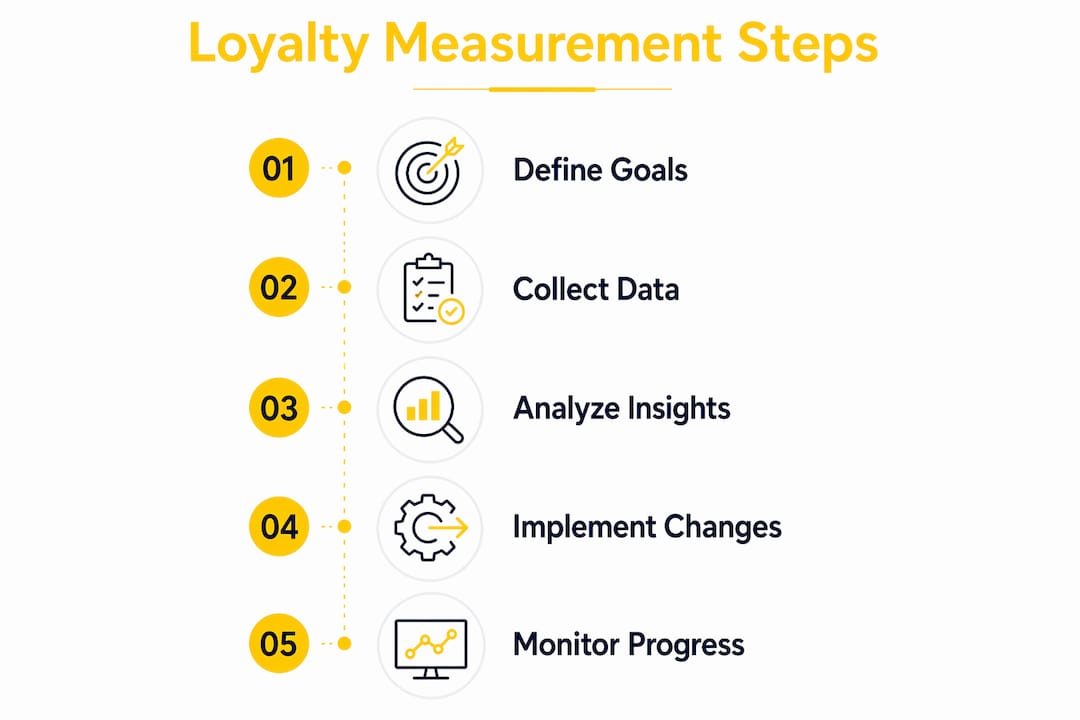
Understanding customer loyalty metrics is only valuable if the findings translate into decisions. The most effective applications of loyalty research follow a clear pattern: diagnose, prioritise, act, and track.
Pro Tip: When presenting loyalty research findings to senior leadership, always anchor attitudinal data to a financial metric. “Our NPS has risen by 8 points” is interesting. “Our NPS has risen by 8 points, and our highest-NPS segment has a CLV 2.4 times higher than our lowest” is a business case.
Customer loyalty research is most valuable when it combines behavioural metrics, attitudinal scores, and qualitative insight to explain not just whether customers stay, but why they do and what would change that.
Most organisations I work with have some form of loyalty measurement in place. Very few have a loyalty research programme. The difference matters more than it might appear.
A measurement programme tells you your NPS score each quarter. A research programme tells you what is driving that score, which customer segments are most at risk, and what specific changes would move the needle. The first is reporting. The second is intelligence.
The most common mistake I see is treating satisfaction as a proxy for loyalty. A customer can be satisfied with their last interaction and still be actively considering switching. Satisfaction is a lagging indicator of a single experience. Loyalty is a forward-looking indicator of relationship strength. Effective loyalty research must move beyond satisfaction to uncover what drives repeat behaviour and long-term relationships.
The second mistake is running loyalty research as a one-off project rather than a continuous process. Customer motivations shift. Competitive alternatives change. A loyalty driver that was strong three years ago may now be table stakes. The organisations that use loyalty research most effectively treat it as a standing programme, not a periodic audit.
My honest recommendation is to start by combining advocacy and diagnostic metrics at the journey level, not just at the overall relationship level. Where in the customer journey is loyalty being built or eroded? That question is far more useful than an aggregate score, and it points directly to where investment and change are needed.
Skopos designs and delivers customer loyalty and CX research for organisations across the UK, Europe, and international markets. Our work combines quantitative tracking, qualitative depth research, and customer segmentation to give you a complete picture of loyalty drivers, retention risk, and programme effectiveness.
Whether you need a full loyalty measurement programme, a diagnostic study ahead of a programme redesign, or a one-off segmentation to identify your most valuable customer groups, Skopos builds research that connects attitudinal insight to commercial outcomes. Ask Skopos to discuss your loyalty research needs with our team.
Customer loyalty research is the systematic study of the emotional and behavioural drivers behind repeat purchase, advocacy, and long-term brand commitment. It goes beyond satisfaction measurement to explain why customers stay and what would cause them to leave.
Effective loyalty measurement combines NPS for advocacy, CES for friction, and CSAT for touchpoint satisfaction, alongside qualitative interviews to uncover emotional drivers. No single metric captures the full picture of loyalty health.
Retention measures whether customers remain active. Loyalty explains why they do. A retained customer may stay out of inertia or switching cost, while a loyal customer stays because of genuine preference and trust in the brand.
41% of loyalty programme leaders cite ROI quantification as a key challenge because enrolled members often self-select as already-loyal customers. Pre/post enrolment measurement designs and a combination of financial and attitudinal metrics produce stronger evidence.
Loyalty research is most effective as a continuous tracking programme rather than a periodic study. Longitudinal data reveals trend lines and early warning signals that a single research wave cannot provide, particularly in subscription and B2B contexts.