

June 24, 2026

9
min read
What is digital experience research? A guide for professionals
Digital experience research helps brands understand user behaviour across websites, apps and digital services.

Digital experience research helps brands understand user behaviour across websites, apps and digital services.

Digital experience research is the systematic study of how users interact with digital touchpoints, including websites, apps, and online services, to understand their needs, behaviours, and expectations. It sits at the intersection of market research and product development, giving business professionals, marketers, and product managers the evidence they need to build better digital products and improve customer engagement. Unlike gut instinct or web analytics alone, digital experience research produces the structured insight that turns raw data into decisions.
Digital experience research is defined as the practice of studying user needs, expectations, and actual experiences across digital touchpoints to improve products and customer journeys. The industry term most closely associated with this practice is UX research, though digital experience research is broader. It covers the full range of digital interactions a customer has with a brand, not just the usability of a single screen.

The distinction matters for business professionals. UX research tends to focus on individual digital assets such as a checkout flow or a mobile app. Digital experience research considers the wider picture, including how a user moves from a paid search ad to a landing page to a product page and then to post-purchase support. That end-to-end view is where the most commercially significant insights live.
Skopos works with organisations across financial services, technology, and consumer brands to conduct this type of research. The goal is not research for its own sake. The goal is insight that can be acted on by product, marketing, and customer experience teams within a realistic timeframe.
Digital experience research splits into two core types: generative research and evaluative research. Understanding which type you need is the first decision any research programme must make.
Generative research happens before a solution exists. Its purpose is to explore what users want, why they behave as they do, and what problems are worth solving. A product team considering a new self-service portal, for example, would use generative research to understand what tasks customers currently struggle with and what they expect from a digital solution. Without this stage, teams risk building products that solve the wrong problems entirely.
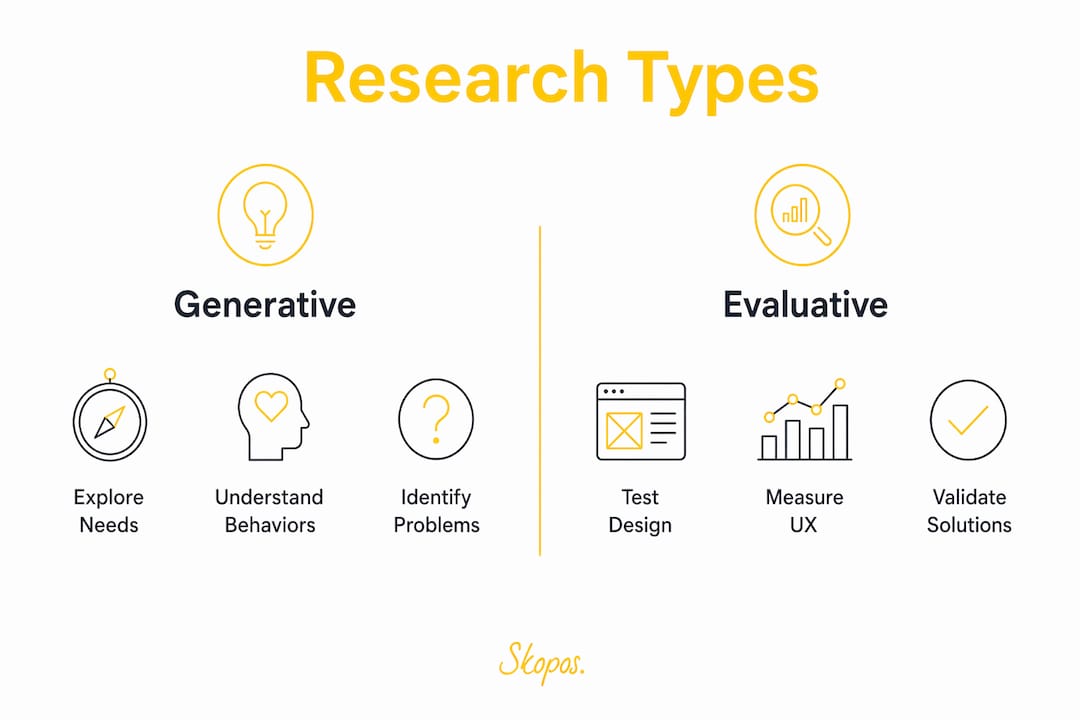
Evaluative research tests an existing design or solution against real user behaviour. It answers the question: does this work as intended? Usability testing, A/B testing, and task completion studies all fall into this category. Evaluative research reduces the risk of building the right thing badly, catching friction points before they reach a live audience.
Both research types draw on qualitative and quantitative methods. Qualitative research captures feelings, motivations, and thoughts, typically through interviews, focus groups, and moderated usability sessions. Quantitative research measures behaviour at scale, tracking metrics such as time on site, conversion rates, task completion rates, and drop-off points.
The two methods work together. Quantitative data tells you where users are struggling. Qualitative data tells you why. Relying on one without the other produces an incomplete picture.
Pro Tip: Start every research project by writing down the specific decision the findings will inform. Research without a clear decision to guide produces data that sits in a report and changes nothing.
Three terms are frequently confused: digital experience research, digital experience monitoring, and digital customer experience. Each serves a different purpose, and conflating them leads to gaps in understanding.
Digital experience monitoring (DEM) focuses on tracking real-time user behaviour and system performance. Tools such as Dynatrace measure availability, page load times, error rates, and user journey observability. DEM tells you that a checkout page is taking four seconds to load and that 30% of users are abandoning at that point. It does not tell you whether users find the checkout confusing, whether they distrust the payment options, or whether they intended to buy at all.
Digital customer experience (DCX), as defined by Salesforce, covers end-to-end online interactions across multiple touchpoints, including email, social media, live chat, and website engagement. DCX is a business outcome and a brand perception. Digital experience research is the method used to understand and improve it.
The table below clarifies how the three concepts relate.
The most effective organisations combine all three. Monitoring tools complement research by surfacing where problems occur, while research explains the motivations behind them. DCX strategy then uses both to set priorities across the full customer journey.
Pro Tip: If your team only has access to monitoring dashboards, treat that data as a list of hypotheses, not conclusions. Each friction point flagged by Dynatrace or a similar tool is a question that only qualitative research can answer.
Digital experience research reduces wasted resources by validating user needs early and testing solutions before they go live. That two-stage protection, generative research before build and evaluative research before launch, prevents the most expensive type of failure: shipping a product that users do not want or cannot use.
The commercial impact extends beyond cost avoidance. Research informs design improvements that enhance satisfaction and conversion rates, directly affecting revenue. A financial services firm that identifies a confusing onboarding flow through usability testing and fixes it before launch protects both customer acquisition costs and early retention rates.
Key business outcomes supported by digital experience research include:
Digital experience analytics aggregates user behaviour at scale, revealing journey insights including friction points and conversion drivers across platforms and devices. That scale of evidence shifts internal conversations from opinion to fact.
Effective digital experience research starts with a clearly defined objective tied to a specific business decision. Without clear goals, teams gather data but fail to influence outcomes. The research question must be specific enough to guide method selection and broad enough to produce findings that matter beyond a single team.
For business professionals commissioning research rather than conducting it, the following principles apply:
Skopos approaches UX and usability research by combining qualitative depth with quantitative scale, ensuring findings are both meaningful and statistically grounded. The buyer journey also shapes research design. Understanding how customers move through digital touchpoints before they convert helps frame the right research questions from the outset.
Pro Tip: Pilot your research instruments, whether a survey, discussion guide, or task scenario, with two or three internal colleagues before going into field. Problems that seem obvious in design become invisible to the researcher and only surface when a real participant is confused.
Digital experience research produces its greatest commercial value when generative and evaluative methods are combined with real-time behavioural data to guide specific, pre-defined business decisions.
The most common failure I see in digital research programmes is not poor methodology. It is poor positioning within the organisation. Research gets commissioned late, after a product decision has already been made, and then used to validate rather than inform. That is expensive and, frankly, a waste of good research.
The shift that makes the biggest difference is treating digital experience research as a continuous input rather than a one-off project. Organisations that build regular research rhythms, whether through quarterly usability reviews, ongoing customer panels, or always-on behavioural analytics, make faster and better decisions than those that commission research only when something has already gone wrong.
The other pattern worth challenging is the assumption that quantitative data is more credible than qualitative insight. Dashboards feel authoritative because they produce numbers. But a session recording showing a user repeatedly clicking a non-interactive element, or an interview where three customers describe the same point of confusion in identical language, carries just as much evidential weight. The skill is knowing how to translate research findings into decisions that product and marketing teams will actually act on.
AI-assisted analysis is changing the speed at which qualitative data can be processed, but it has not changed the need for human judgement in interpreting findings. The organisations that will use digital experience research most effectively in the coming years are those that pair modern tooling with experienced researchers who understand commercial context. That combination is where the real value sits.
Skopos brings together qualitative and quantitative research expertise to help brands understand how their customers experience digital products and services. Whether you are building a new digital proposition, optimising an existing journey, or trying to understand why engagement is falling short of expectations, structured research produces the evidence that internal data alone cannot.
Skopos works with organisations across the UK and internationally, combining UX and user journey research with broader market and customer insight to give teams a complete picture. For professionals new to the field, the Skopos Market Research Glossary covers over 200 key terms and definitions. To discuss a research programme tailored to your digital objectives, explore Skopos UK market research services or get in touch directly.
UX research focuses on the usability of individual digital assets such as an app or website. Digital experience research is broader, covering the full range of digital interactions a user has with a brand across multiple touchpoints.
The main methods include user interviews, usability testing, surveys, behavioural analytics, and diary studies. Qualitative methods explain user motivations; quantitative methods measure behaviour at scale.
Digital experience monitoring tracks real-time performance metrics such as page load times and error rates. It identifies where problems occur but cannot explain why users behave as they do. Research provides that explanation.
Digital experience research reveals how customers perceive and interact with a brand’s digital channels, directly informing content, journey design, and campaign targeting decisions that affect conversion and retention.
Define the specific business decision the research will inform before selecting any method. Without a clear decision to guide the work, findings rarely influence outcomes.